Contract Manufacturing in Vietnam: OEM, ODM and Turnkey Assembly Explained
Contract manufacturing is how most importers actually buy from Vietnam. You own the design, the brand and the specification, and a factory makes the product to your instructions. It is also where we see the most expensive misunderstandings: who owns the tooling, who is liable for a defect, and what “Made in Vietnam” will really cost you at the border. This guide puts the answers in one place.
What contract manufacturing actually means
The terms get used loosely, so it helps to pin them down before you ask anyone for a quote.
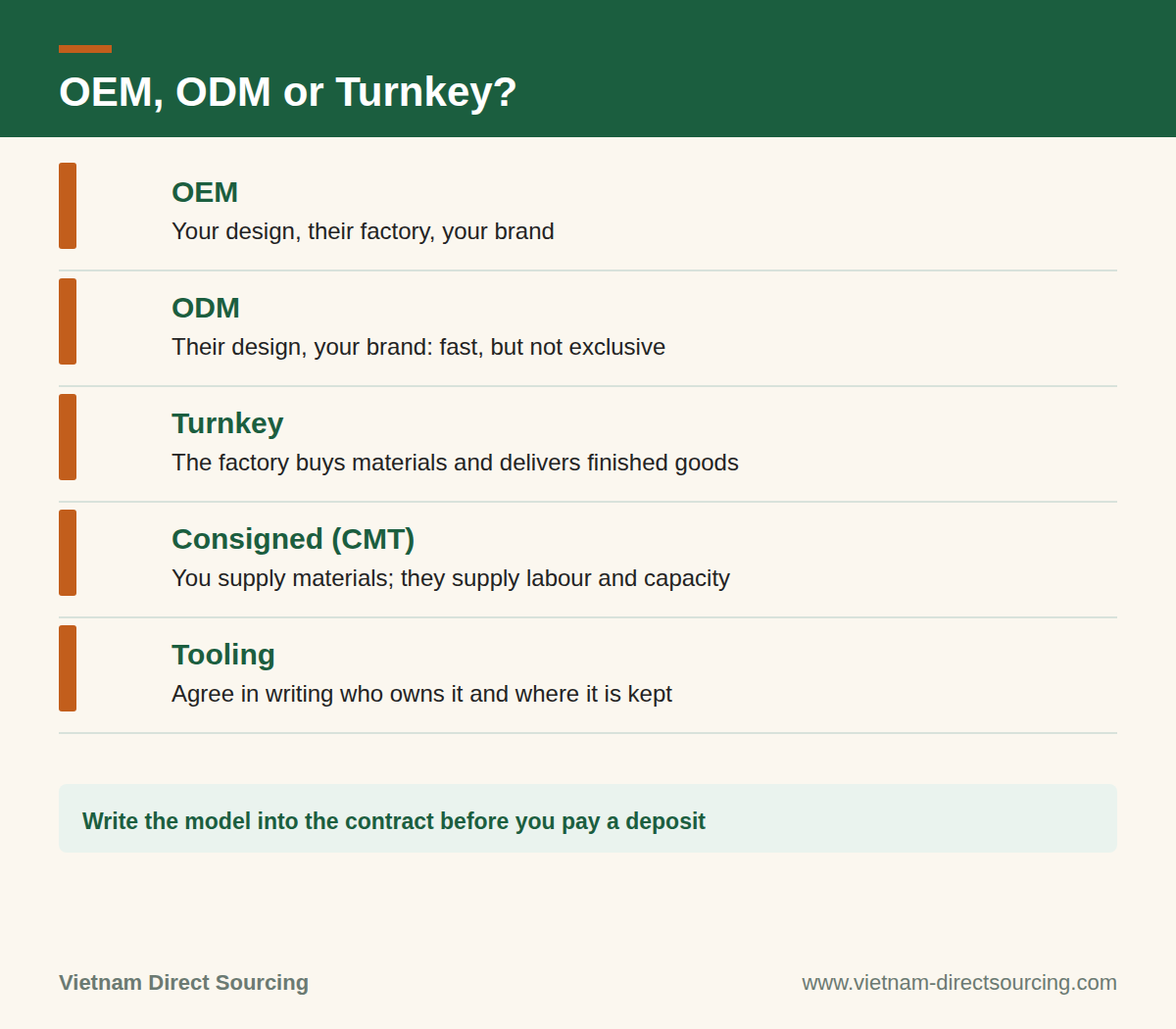
- Contract manufacturing is the umbrella term: you hire a factory to make a product to your design and specification.
- OEM (original equipment manufacturer) means the factory builds your design under your brand. You own the design; they supply the process, the labour and the capacity.
- ODM (original design manufacturer) means the factory designs, or already owns, the product and you put your brand on it. It is faster and cheaper to start, but less defensible, because another buyer can often order the same design.
- Turnkey means the factory buys the materials and components and delivers finished goods against one price. Consigned work (often called CMT in garments) means you supply the materials and they supply labour and capacity.
None of these is better in the abstract. Turnkey is simpler but leaves you dependent on the factory’s purchasing. Consigned gives you control of materials and more logistics to manage. Decide which model you are buying, and write it into the contract before you pay a deposit.
Why buyers are looking at Vietnam
The usual reason is diversification, but there are practical ones too. Vietnam has deep manufacturing clusters in electronics, furniture, textiles and footwear, plastics and metal fabrication, and it is party to a long list of trade agreements, including CPTPP, RCEP, AANZFTA, the EU–Vietnam agreement and the UK–Vietnam agreement. Qualifying goods can enter several major markets at reduced or zero duty. Labour costs are lower than in China at the bottom of the scale: the Region I legal minimum wage rose to VND 5.31 million a month in January 2026, roughly US$200. That is a legal floor, not what skilled factory staff are paid, so treat it as a direction rather than a budget.
Two cautions belong here. First, Vietnam is not tariff-free into the United States, which we cover below. Second, Vietnamese factories rely heavily on imported inputs. In the first seven months of 2025, about 40% of Vietnam’s imports came from China. Ask every supplier where the key components come from, because it affects your costs, your lead times and your origin paperwork.
What Vietnam does well, and where to look
- Electronics assembly and components — concentrated in the north. See our guide to electronic component manufacturers in Vietnam.
- Furniture and wood products — the southern industrial belt around Ho Chi Minh City, Binh Duong and Dong Nai for integrated export furniture. Our furniture and wood manufacturers guide covers how to tell a factory from a trader.
- Garments, footwear and textiles — Vietnam’s strength is making-up rather than weaving, so fabric is often imported. Read organic fabric suppliers in Vietnam before you commit.
- Metal fabrication and machining — see steel and metal fabrication suppliers.
- Packaging and plastics — including biodegradable and compostable packaging.
- FMCG and private label — start with how to request an FMCG quote.
What it really costs: beyond the unit price
A quote is one number. The cost of a contract manufacturing programme is several:
- Tooling and moulds — often a one-off charge, and the item most likely to cause a dispute later. Agree who pays, who owns it, where it is kept and whether you can move it.
- Minimum order quantities — set by the factory’s own suppliers as much as by the factory. See understanding MOQs in Vietnamese factories.
- Samples and first-article approval — budget time and money for more than one round.
- Quality control — in-line checks and a pre-shipment inspection against a written standard.
- Freight, duty and compliance — the full picture is your landed cost. Our landed cost guide shows how to build it.
On payment terms, a deposit on order (often around 30%) with the balance against shipping documents or before release is common for new buyers. Letters of credit are unusual at smaller volumes. These are norms, not rules, and they are negotiable once you have a track record.
Where tariffs stand
As at 26 October 2026, goods of Vietnamese origin entering the United States pay the normal duty for the product plus a 12.5% Section 301 duty introduced in late July, after the Supreme Court struck down the earlier emergency tariffs in February. Steel, aluminium, copper and timber products can also attract Section 232 duties whatever their origin. Chinese-origin goods pay the same 12.5% and, on many products, older Section 301 duties of 7.5% to 25% on top. So the gap in Vietnam’s favour is smaller than it was in 2025, and it depends on your product, not on a headline. A US–Vietnam trade agreement and a separate Section 301 investigation into Vietnam’s intellectual property protection are both still pending. Price your actual tariff code and check it again before you place the order.
For Australia and New Zealand, AANZFTA and RCEP can bring qualifying goods in duty-free, but only with correct origin paperwork. Our guides to AANZFTA, CPTPP and RCEP and the AANZFTA upgrade explain the rules of origin.
Protect your IP and your tooling
Contract manufacturing means handing over your design, so protect it before you do.
- Register your trademark in Vietnam first. Vietnam’s trademark system is first-to-file, which means the first applicant, not the first user, owns the right.
- Use a confidentiality, non-use and non-circumvention agreement (often called an NNN agreement) drafted under Vietnamese law and in Vietnamese as well as English, so it can actually be enforced where the factory is.
- Put tooling ownership in writing, mark the tools with your name and keep photographs and records.
- Share on a need-to-know basis. Split drawings and specifications where you can, and do not send the full technical package until the supplier has passed evaluation.
The US Trade Representative opened a Section 301 investigation into Vietnam’s IP protection and enforcement on 29 May 2026, and no decision had been published when we checked. It is another reason to rely on your own agreements rather than on the system.

How to qualify a contract manufacturer
This is the work that separates a good first order from an expensive lesson.
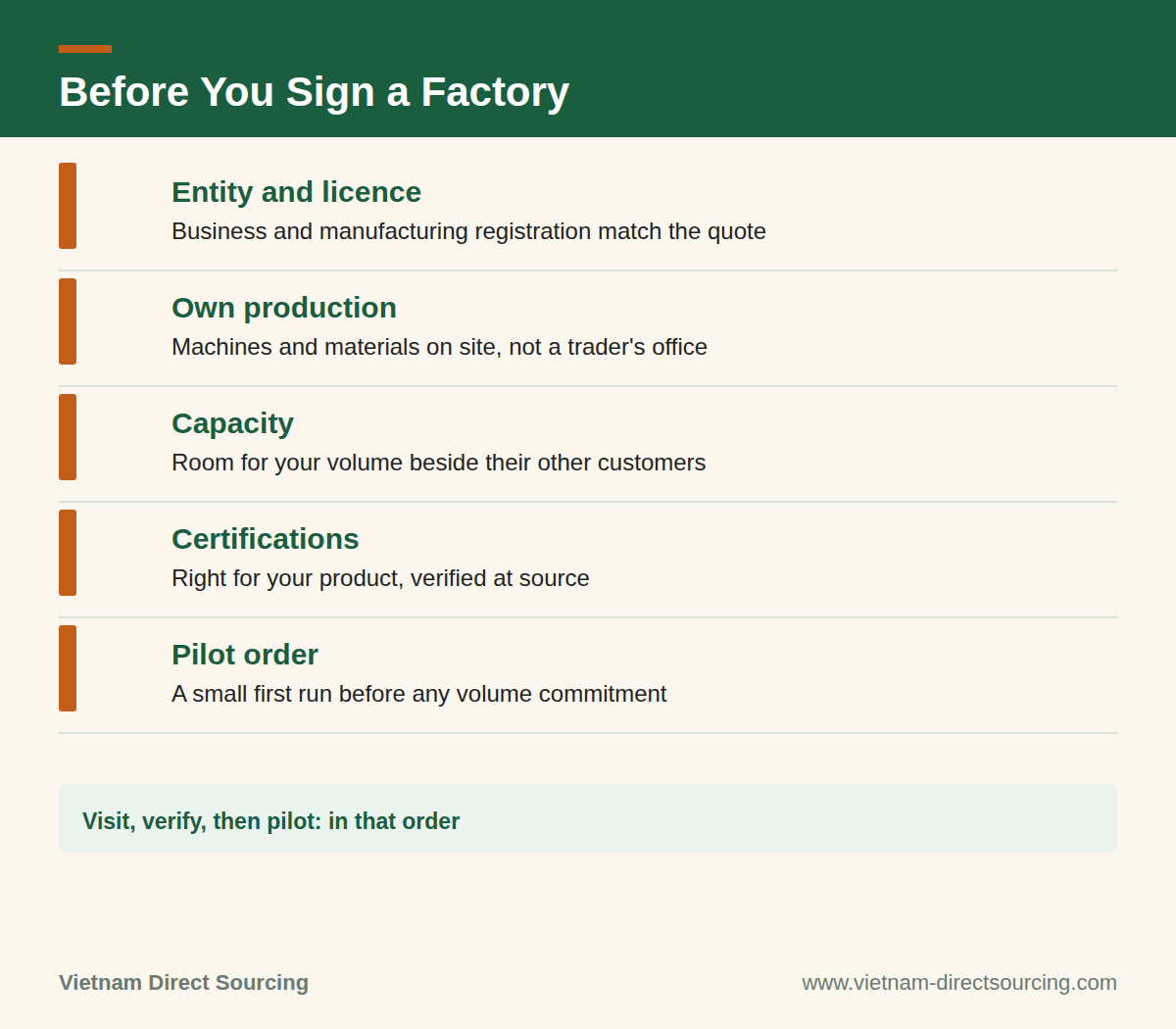
- Confirm the legal entity and its manufacturing registration, and that the name on the quote matches the name on the licence.
- Establish whether they make the product themselves or subcontract it. Visit, and look for the machinery and the raw material staging.
- Check capacity against your volume, and ask what share of that capacity your order would use alongside their other customers.
- Verify the certifications that matter for your product at source: ISO 9001 for quality management, ISO 13485 for medical devices, IPC standards for electronics, and a social compliance audit such as BSCI or SMETA if your own customers require one.
- Review a sample made to your specification, then agree a first-article inspection before production starts.
- Start with a pilot order. A small first run costs less than a large one that goes wrong.
Running the programme day to day
Once production starts, the discipline is in the detail. Lock the specification and run every change through a written change request, so the factory is never working to two versions. Agree production milestones and ask for photographs at each one. Inspect early as well as before shipping, because a defect found at the pre-shipment stage is far cheaper to fix than one found in your warehouse. If you need a refresher on the documents, our guides to the product specification sheet, the request for quotation and manufacturing contracts are the place to start.
Five mistakes we see again and again
- Choosing on unit price alone. The cheapest quote often leaves out tooling, packaging or inspection.
- A vague specification. If it is not written down, the factory will fill the gap with its cheapest option.
- Skipping the pilot order. Volume commitments before a proven first run are where the money is lost.
- Leaving tooling ownership unwritten. It becomes a problem the day you want to change factory.
- Assuming a zero tariff. Duty depends on your product, your origin paperwork and the market you sell into.
A worked example
This is an illustration, not a client story. Take a US homewares brand moving a metal-and-bamboo storage product from a Chinese supplier. The Vietnamese quote is 8% higher ex-works. If the product sits on a Chinese Section 301 list at 25%, the Chinese route pays that 25% on top of the shared 12.5%, while the Vietnamese route pays only the 12.5%. A 25-point duty gap is enough to turn an 8% higher unit price into a lower landed cost. If the same product were on no Chinese list, the two routes would carry the same duty, and the Chinese quote could win. The answer depends on the product, which is why we work it out line by line.
The bottom line
Contract manufacturing in Vietnam works well when you decide the model first, protect your IP and tooling in writing, qualify the factory rather than the brochure, and price the programme on landed cost with the tariffs as they stand today. Start small, inspect early and keep the paperwork tidy. Our sourcing solutions cover each stage, from Supplier Identification and Supplier Evaluation to production management and Quality Assurance.
Tariff positions and rates in this article were checked on 26 October 2026 and can change quickly. Always confirm the current position for your product before ordering.
Ready to get started? Vietnam Direct Sourcing is here to help. With local expertise and a trusted network of suppliers, we’ll make sure your sourcing journey is as smooth as possible.
Not sure where to start? See how our Vietnam sourcing solutions work, from supplier identification to quality assurance.
Listen to the episode
This topic is also a short episode of the VDS podcast, on YouTube and Spotify.


What a Vietnam Sourcing Agent Actually Does (and What It Costs)
