



Organic Cotton, Bamboo & Hemp Fabric from Vietnam: GOTS and OEKO-TEX Explained
Most buyers start this conversation in the wrong place. They go looking for a Vietnamese mill that will sell them certified fabric by the roll, find the list is short and the minimums are unfriendly, and conclude that Vietnam cannot do organic. The list is short. The conclusion is wrong. Vietnam’s strength is not selling you cloth — it is turning cloth into a finished, labelled, inspected product at a scale and quality level almost nobody else matches, and that is where a certified programme should sit.
What Vietnam is world-class at
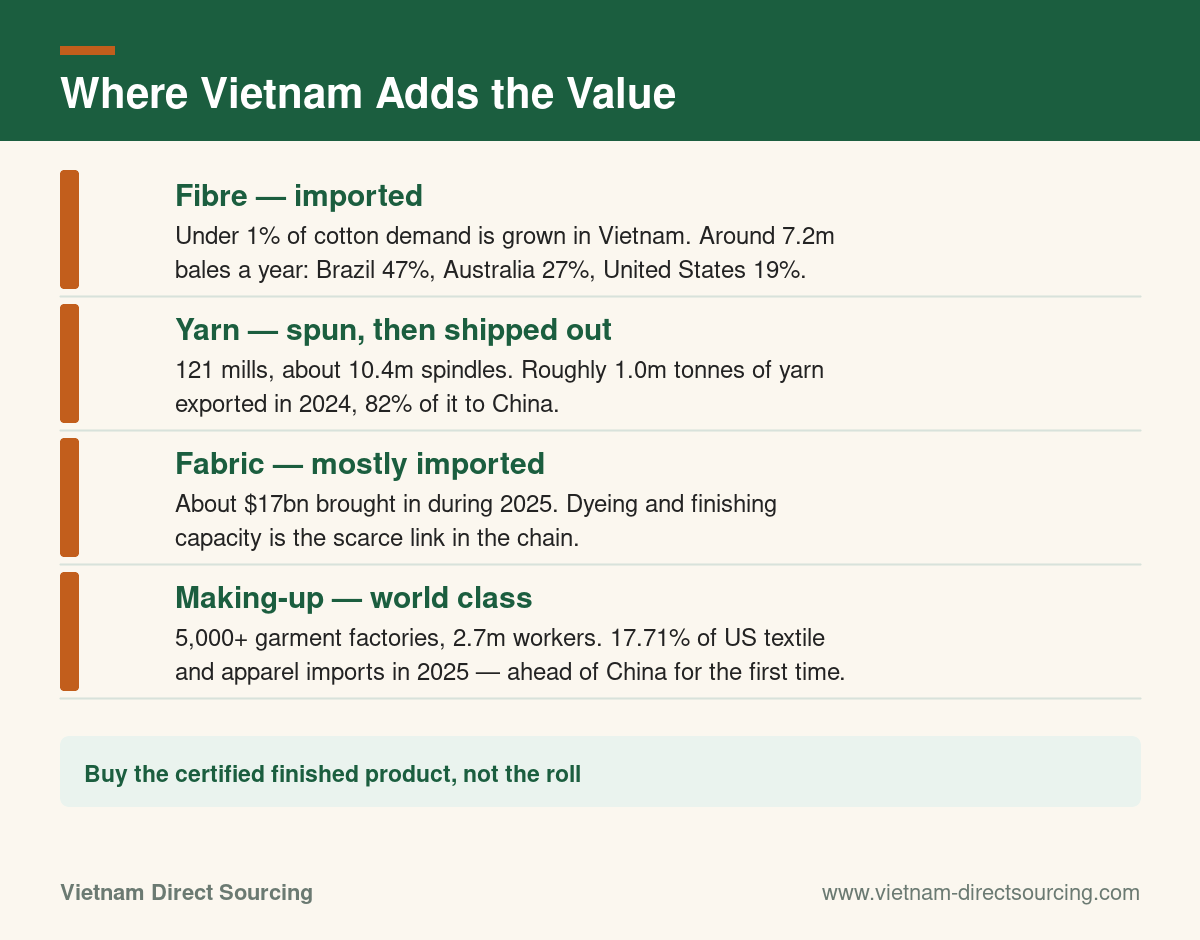
More than 5,000 garment factories, around 2.7 million workers, and roughly US$46 billion of textile and garment exports in 2025. In that year Vietnam passed China to become the largest supplier of textiles and apparel to the United States, taking 17.71% of a US$104 billion import market against China’s 16.96% — the first time the ranking has changed hands. It has also overtaken China in categories that are genuinely hard to sew, jackets and blazers among them.
The industry has spent a decade climbing out of cut-make-trim into full-package FOB and, increasingly, ODM — where the factory buys the materials, engineers the construction and carries the technical risk. That shift is the whole point for anyone buying certified goods, because a full-package maker already owns a qualified materials chain and the paperwork that comes with it.
The fabric position, in three numbers
Under 1% of the cotton Vietnam consumes is grown there — mills import around 7.2 million bales a year, Brazil about 47%, Australia 27%, the United States 19%. Spinning is strong (121 mills, some 10.4 million spindles) but roughly a million tonnes of yarn went out again in 2024, 82% of it to China. And about US$17 billion of fabric came back in during 2025.
Behind those numbers sits one constraint: wet processing. Dyeing and finishing need capital, effluent treatment and a province willing to zone for it. Southern capacity clusters around Long An and Tây Ninh, the central region has almost no industrial land left for it, and Decree 205/2025’s 10% corporate tax rate for 15 years will take years to turn into plants. Certified knitting is easy to find in Vietnam. Certified dyeing under the same roof is where a shortlist collapses.
So buy the made-up product, not the roll
The practical consequence is a choice about who owns the material. Buy fabric by the roll and you own the dyeing risk, the fabric minimums, the storage and the transaction certificates all the way down — in the one part of the chain Vietnam is weakest at. Place a full-package order and the maker buys the certified fabric, often from an established mill inside or outside Vietnam, and hands you finished goods with the certification chain already assembled.
GOTS supports exactly this. A making-up facility can hold certification in its own name, and the transaction certificate that matters to you is the one covering the finished goods you are importing, not the greige fabric three steps upstream. Your supplier evaluation moves accordingly: you are qualifying a manufacturer and its materials chain, not hunting for a weaving shed.
There is still a nominated-mill option, and it is the right one when you have a fabric you cannot compromise on — a proprietary construction, a matched colour across seasons. Just be clear that nominating the mill moves the wet-processing risk back onto your side of the table, and be sure your quality assurance plan covers it.
Where the chain actually breaks
- Scope versus transaction — a scope certificate says a facility was approved for named processes between two dates. The transaction certificate says your consignment came out of that approval. Suppliers volunteer the first and forget the second. For a full-package order, check that making-up is inside the scope, not just trading.
- Subcontracted wet processing — given the dyeing shortage this is the country’s characteristic failure mode. A certified knitter books an uncertified dye house, and the certificate you were sent is genuine but irrelevant to your goods.
- Bamboo — almost all of it is viscose regenerated from pulp, outside GOTS by definition, and in several markets it cannot be labelled simply as bamboo. The honest claim set is OEKO-TEX STANDARD 100 on the finished article plus certified pulp.
- Hemp — the highland handweave around Hà Giang and Lào Cai is real, and artisanal in volume and width. Container-scale hemp runs on imported yarn, which changes your rules-of-origin position rather than your ethical sourcing story.
Whose programmes the factory already runs
The United States takes roughly 38% of Vietnam’s textile and garment exports, Japan around 11% and the European Union about 9.4%. A factory’s certification posture follows its customers: plants built around US programmes optimise for chemical testing and social audits, while GOTS turns up where European organic programmes pay for it. An Australian or Canadian importer placing a modest first order is a small account in a plant running US programmes — lead with repeat container volume and a forecast, because that is what buys MOQ flexibility and administrative attention.
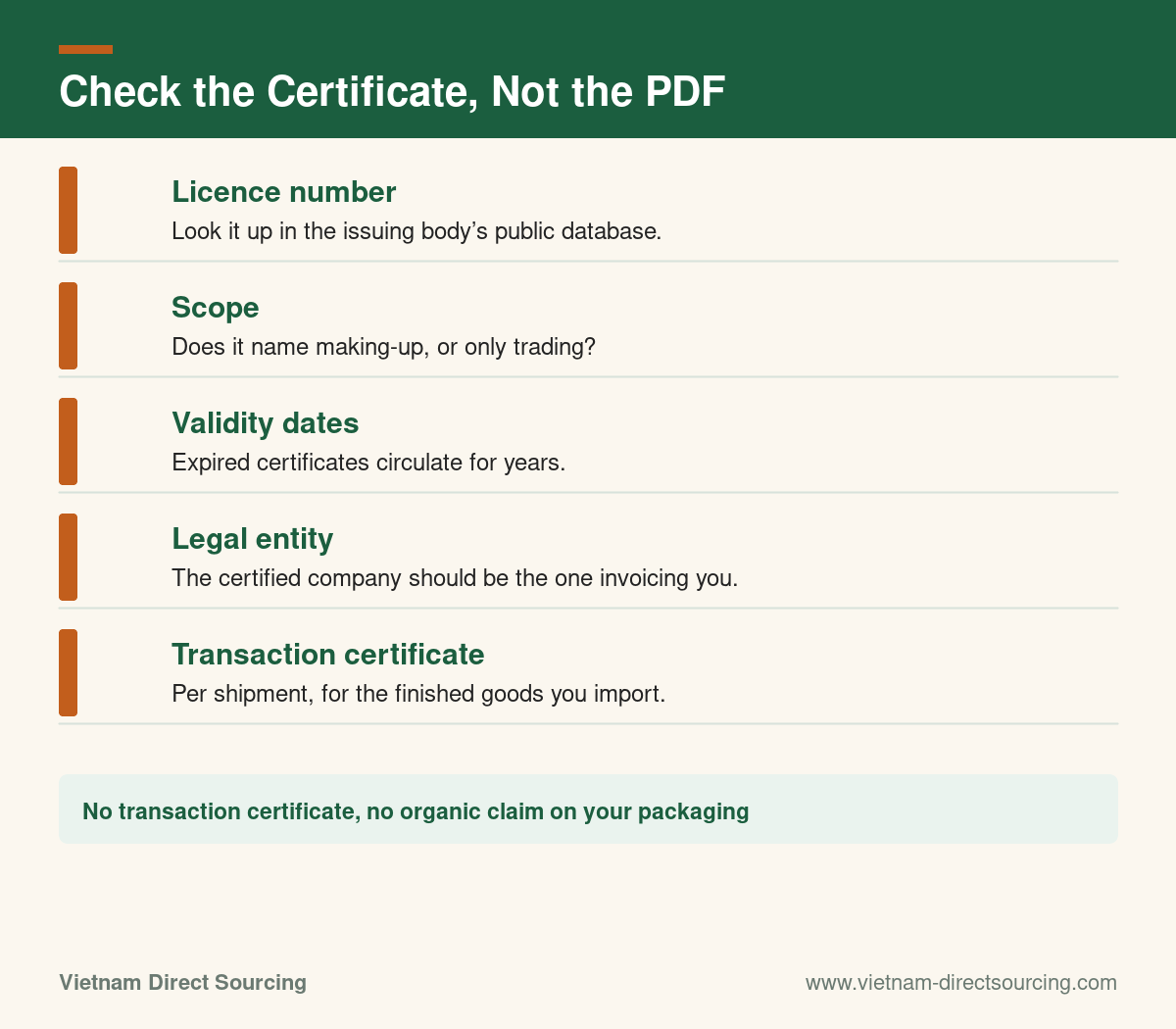
Ten minutes of verification
- Licence number — check it in the issuing body’s public database, not in the PDF that was emailed to you.
- Scope — confirm it names making-up, and the wet processing behind it, rather than trading alone.
- Validity dates — expired certificates circulate for years, and a factory mid-renewal is not certified today.
- Legal entity — the certified company should be the company invoicing you. Often it is not.
- Transaction certificate — per shipment, for the finished goods you are importing. No transaction certificate, no organic claim on your packaging.
Alongside the paperwork, the ordinary quality assurance still applies: GSM, shrinkage, colourfastness to washing and rubbing, and pilling, tested against a written specification and an approved bulk sample before the line runs.
A wholesale bedding importer came to us holding a quotation for GOTS-certified organic cotton sheeting, priced well below anything else they had seen. The scope certificate was genuine — it belonged to a knitting mill that was not the company quoting, and its scope did not cover dyeing. The supplier was a trading office buying greige fabric and having it dyed at an uncertified plant. We moved the programme to a full-package maker holding GOTS in its own name for making-up, with a certified fabric supply it had used for years. The buyer paid a few per cent more, stopped managing fabric altogether, and got transaction certificates with each shipment.
The bottom line
Vietnam is a converting country. The fibre is imported, the fabric is largely imported, and the dyeing capacity is genuinely tight — but the making-up is world-class, now first into the United States, and moving steadily up into full-package and ODM work. Buy accordingly: qualify a manufacturer and its materials chain rather than chasing rolls, confirm making-up sits inside the scope, and insist on a transaction certificate for the finished goods with every shipment.
Ready to get started? Vietnam Direct Sourcing is here to help. With local expertise and a trusted network of suppliers, we’ll make sure your sourcing journey is as smooth as possible.
Not sure where to start? See how our Vietnam sourcing solutions work, from supplier identification to quality assurance.
Learn more about this topic on our podcast!
Want to dive deeper into this subject? Check out our latest podcast on this subject on Spotify, where we explore this topic and so much more! Whether you're on the go or relaxing at home, tune in for insights, tips, and discussions that bring our blog topics to life.



How to Source Construction Materials from Vietnam
