




How to Source Construction Materials from Vietnam
Most importers who source from Vietnam are already buying furniture, textiles or electronics from the country and have never thought to ask what else comes off the same production base. Construction materials are the easiest category to add: the industrial base is mature, the products are made to internationally recognized standards, and Vietnam’s deep-water ports make bulk freight straightforward rather than exotic.
Why Vietnam for construction materials
Vietnam ranks eleventh globally in crude steel production — roughly 24.6 million tonnes in 2025 — and is a net exporter, meaning domestic supply isn’t competing with export capacity the way it does in some markets. Cement and clinker exports have been rising through 2026 on the back of abundant limestone reserves and a decade of heavy industrial investment. Combine that with production to ASTM, BS and EN standards and you get a sector genuinely built for export, not domestic use with export as an afterthought.
What you can realistically source
- Structural steel — rebar, wire rod, hot-rolled coil and structural sections. Hoa Phat Group alone produces roughly 11 million tonnes a year, about 45% of national output; Formosa Ha Tinh runs one of Southeast Asia’s largest integrated flat-steel complexes; VNSteel and Ton Hoa Sen round out the major suppliers of galvanized and coated products.
- Cement and clinker — Portland cement at competitive pricing, with export volumes growing through 2026.
- Tile, sanitaryware and stone — ceramic and porcelain tile, sanitaryware, marble, granite and engineered quartz, plus a well-regarded niche encaustic cement tile industry.
- Glass — float and tempered glass for construction and glazing applications.
- Timber and composite products — non-fired brick, roofing materials, and wood-plastic composite (WPC) decking and cladding.
- Modern building components — aluminum window and door systems, prefabricated wall panels.

Regional supply map
The north carries the cement belt around Ninh Binh and the Hai Phong corridor, alongside the country’s steel and heavy-industry base. The center is anchored by Formosa Ha Tinh’s integrated steel complex. The south — Binh Duong, Dong Nai and Ho Chi Minh City — is the center of gravity for tile, ceramics, sanitaryware and glass, with the strongest export logistics infrastructure of the three regions.
Verifying a supplier before you commit
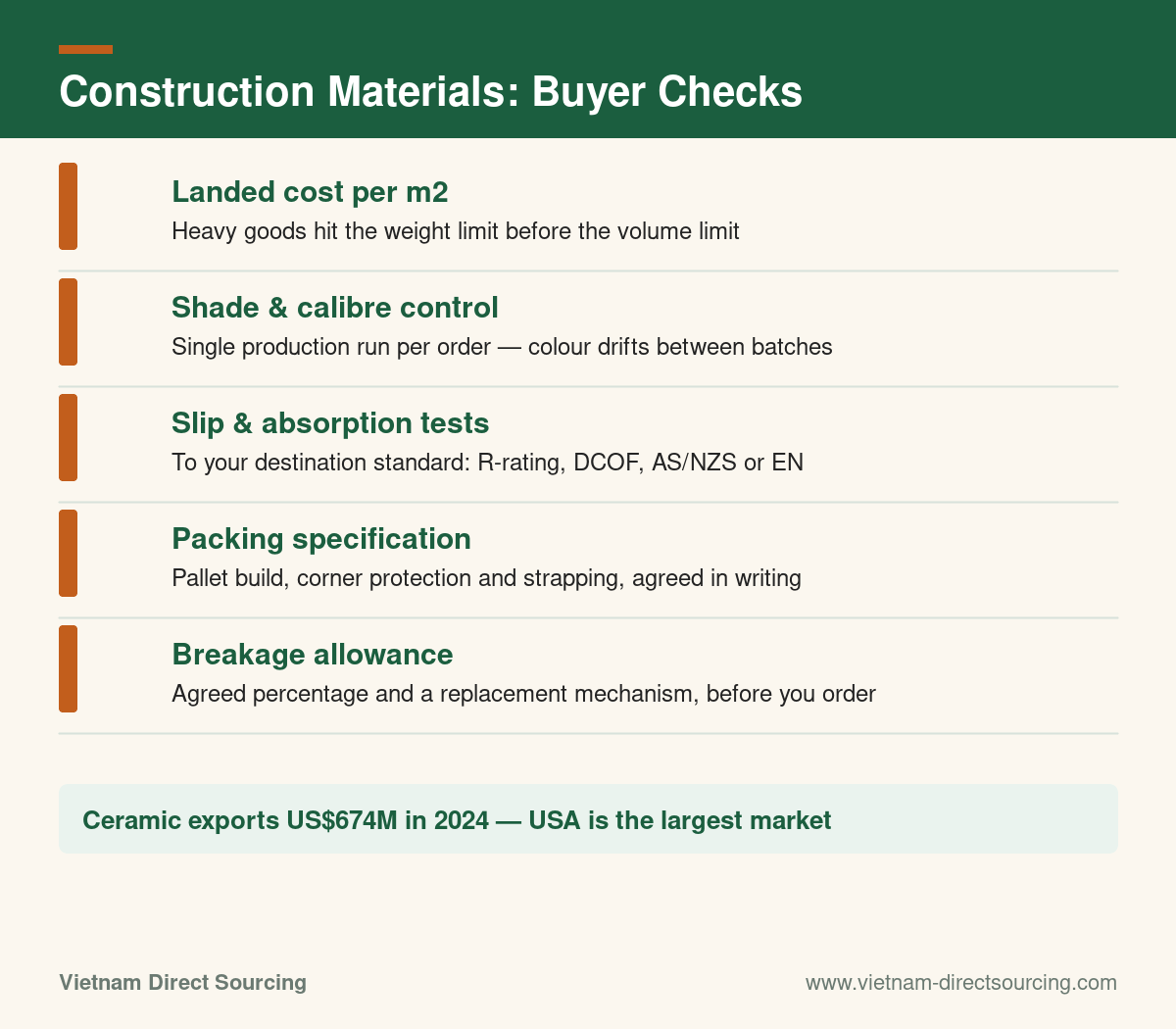
Construction materials are heavy, expensive to ship, and unforgiving of quality shortcuts discovered after the container has landed. Confirm ISO 9001 as a baseline, and for any steel product, ask for Mill Test Reports (MTRs) that trace back to the heat or batch number — not a self-declared certificate that doesn’t match the packing list. Order physical samples and have them independently tested in your home market against the relevant ASTM, BS or EN standard before placing a production order. For significant volumes, a factory audit is worth the cost: it’s the only reliable way to confirm real production capacity versus a trading company presenting itself as a factory. And insist on in-production inspection — a defect caught mid-run is cheap to fix; the same defect discovered after a container of tile or roofing sheet has landed is not.
Logistics and payment realities
Freight is the dominant cost driver for bulk materials, more than for almost any other product category — work out your full landed cost, including duties and port handling, before you compare factory quotes rather than after. Not every freight forwarder handles bulk or breakbulk construction cargo well, so use one with specific experience in the category. Letters of credit are standard for larger orders and protect both sides, but only if your contract has fully documented specification, tolerances, delivery terms and remedies for non-conformance before the LC is opened — negotiating those terms after the fact is the wrong order of operations.
An Australian building-products importer came to us with a quote for galvanized roofing sheet that undercut their existing supplier by 15%. The mill test reports the factory supplied didn’t match the heat numbers on the actual packing list. Our audit found the plant was reselling coil bought on the spot market rather than rolling to the stated coating-weight specification. We moved the order to a Hai Phong mill that could produce matching, heat-traceable MTRs. Landed cost came in about 6% above the original quote — well under what a rejected shipment at the port would have cost.
The bottom line
The manufacturers and the standards are both real — the risk in construction materials sourcing sits almost entirely in verification. Confirm a supplier’s actual capacity, catch a spec substitution before production rather than after, and have someone on the ground during production runs instead of trusting photos. Get that right and Vietnam is a genuine one-stop source for a construction materials program, not just the country you already buy furniture from.
Ready to get started? Vietnam Direct Sourcing is here to help. With local expertise and a trusted network of suppliers, we’ll make sure your sourcing journey is as smooth as possible.
Not sure where to start? See how our Vietnam sourcing solutions work, from supplier identification to quality assurance.
Learn more about this topic on our podcast!
Want to dive deeper into this subject? Check out our latest podcast on this subject on Spotify, where we explore this topic and so much more! Whether you're on the go or relaxing at home, tune in for insights, tips, and discussions that bring our blog topics to life.



How to Find Electronic Component Manufacturers in Vietnam

Leave a comment
Your email address will not be published. Required fields are marked *