




How to Find Electronic Component Manufacturers in Vietnam
Most buyers still picture Vietnam electronics as a Samsung assembly line — phones and TVs going out the door, components coming in from somewhere else. That’s half true. Vietnam’s electronics sector exported roughly $165 billion last year, over a third of the country’s total exports, and a real base of independent PCB and contract-assembly factories has grown up around the anchor tenants. If you’re sourcing components or board assemblies and haven’t looked past the Samsung headline, you’re missing the part of the market that will actually take your order.
Why Vietnam for electronics manufacturing
Computers, electronics and components cleared $100 billion in Vietnamese exports for the first time last year, with phones and components contributing a further $56.7 billion. Samsung’s Vietnam factories now account for over half of its global smartphone output, anchored in Bac Ninh — the country’s single largest electronics hub at roughly $42 billion in net revenue — with Thai Nguyen and Hai Phong not far behind. Investment disbursement hit a five-year high of $27.6 billion in 2025, and the industry is visibly shifting from simple assembly toward semiconductors and AI hardware, with NVIDIA and Qualcomm both setting up R&D centers.
What you can realistically source
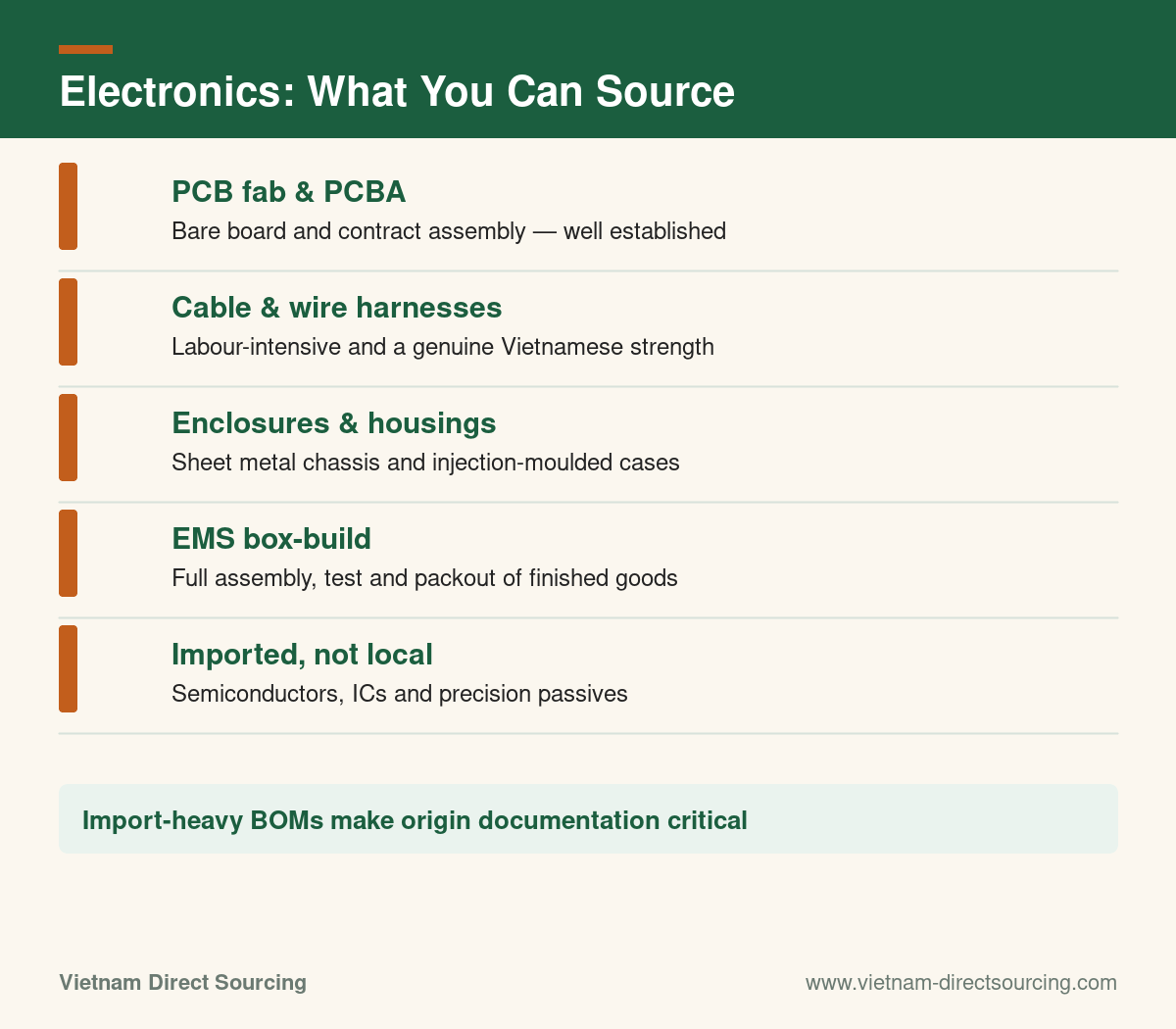
- PCB fabrication and PCBA (assembly) — bare board manufacturing and populated-board assembly. This is where Vietnam’s independent factory base is deepest and most accessible to outside buyers.
- Contract EMS for finished devices — IoT modules, set-top boxes and consumer electronics sub-assemblies, built to your design.
- Cable assemblies and connectors — wiring harnesses, connector assembly and cable-set manufacturing for OEM programs.
- Enclosures and mechanical parts — injection-molded housings, stamped metal enclosures and bracketry to pair with an assembly order.
- Test and inspection services — AOI, functional test and burn-in, increasingly offered as a standalone service by larger EMS houses.
- Passive components — resistors, capacitors and inductors, though this layer is thinner and leans more heavily on imported content than the categories above.

The “Made in Vietnam” reality check — read this before you commit
Domestic component localization in Vietnam still sits at roughly 5–10%. A board assembled in Bac Ninh can carry meaningful Chinese, Korean or Taiwanese content even when the finished product is genuinely built in Vietnam. That matters for the same reason it matters in steel and every other category currently under trade-defense scrutiny: origin isn’t about the address of the factory, it’s about where the value-adding transformation actually happened. If part of your reason for sourcing here is de-risking from China specifically, ask your factory for a full bill of materials with country of origin against each line before you assume the finished board clears that bar.
Finding and vetting a manufacturer
The ecosystem concentrates in the north — Bac Ninh, Thai Nguyen, Bac Giang and Hai Phong — with a second, more PCBA- and EMS-focused cluster around Ho Chi Minh City and Binh Duong. Trade directories and Samsung’s own supplier network will give you a longlist; they won’t tell you which of those factories can actually hold a defect rate.
Before you send a PO: confirm ISO 9001 at minimum, with ISO 14001 or UL certification as a stronger signal, and IATF 16949 if the end product is automotive. Ask to see the electrostatic discharge (ESD) protocols in person — this is the single most common corner cut by lower-tier assemblers — and confirm AOI and functional test equipment is on the line, not an optional add-on. Have your bill of materials, PCB schematics, enclosure drawings and test specifications ready before first contact; incomplete specs are the most common reason quotes stall. And run a paid sample before committing to a production order, whatever the quote looks like.
A North American importer of smart-home sensors came to us with a quote from a Bac Ninh contract assembler that beat their existing Shenzhen supplier by a wide margin. Our factory audit found the ESD flooring was cosmetic rather than grounded, and the AOI machine hadn’t been calibrated in over a year. We moved the order to a smaller Ho Chi Minh City PCBA house with current calibration records on file. The unit cost came in slightly higher — the first production run passed functional test with a defect rate under 0.3%, and there was no rework to chase six weeks after the container had already shipped.
The bottom line
Vietnam’s electronics ecosystem is genuinely world-scale at the top end, but for an independent buyer that scale is deceptive — most of it belongs to Samsung and its direct Tier 1 network, not to the factory that will quote your order. The vetting is where the value sits: confirmed certifications, real ESD discipline, and a paid sample before the first production run. Do that, and Vietnam earns a real place on your component and assembly shortlist, not just your phone.
Ready to get started? Vietnam Direct Sourcing is here to help. With local expertise and a trusted network of suppliers, we’ll make sure your sourcing journey is as smooth as possible.
Not sure where to start? See how our Vietnam sourcing solutions work, from supplier identification to quality assurance.
Learn more about this topic on our podcast!
Want to dive deeper into this subject? Check out our latest podcast on this subject on Spotify, where we explore this topic and so much more! Whether you're on the go or relaxing at home, tune in for insights, tips, and discussions that bring our blog topics to life.



How to Find Steel & Metal Fabrication Suppliers in Vietnam

Leave a comment
Your email address will not be published. Required fields are marked *