




What a Vietnam Sourcing Agent Actually Does (and What It Costs)
"Sourcing agent" covers three quite different businesses — and the same is true of the procurement agent, sourcing consultant and supply chain consultant you will see advertised in Vietnam. They get paid in ways that pull in opposite directions. Before you engage anyone, it is worth understanding which model you are dealing with, because it tells you, with reasonable accuracy, whose side they are on.
The three models
The commission agent — paid a percentage of what you spend, usually by the factory. Their income rises when your unit price rises. They are often genuinely useful and well connected, but the incentive runs against you, and you rarely see the real factory price.
The trading company — buys from the factory and sells to you, with the margin inside the price. Simple to deal with and they carry some risk, but you have no visibility of the factory, cannot audit it, and cannot leave with the relationship.
The independent sourcing partner — paid by you, in fees, for defined work. You see original factory pricing and pay separately for the service. More transparent, and the incentive points the same way yours does.
We operate the third model, so treat that as a declared interest rather than a neutral observation. The point still stands: ask how the person in front of you gets paid, and by whom.
What the work actually involves
- Market Research and Supplier Identification — establishing whether Vietnam is even the right answer for your product, then building a longlist from the industrial clusters around Hanoi, Da Nang and Ho Chi Minh City rather than a directory search.
- Supplier Evaluation — visiting the factory, verifying it exists and owns its equipment, checking certifications at source rather than accepting PDFs, and confirming capacity against your volume.
- Negotiation and terms — pricing, minimum order quantities, payment terms, tooling ownership and lead times, conducted in Vietnamese with an understanding of what is customary and what is a try-on.
- Production management — following the order through the factory rather than waiting for a shipping notice, and flagging slippage while there is still time to act.
- Quality Assurance and quality control — pre-production samples, in-line checks and pre-shipment inspection against a written standard, with photographic evidence.
- Logistics and compliance — consolidation, freight coordination, and the documentation that determines your duty position at the destination.
How the money works
Commission models typically sit between 3% and 10% of order value, paid by the factory and built into your price whether you see it or not. Trading company margins vary enormously and are invisible by design. Fee-based work is quoted against the task — a supplier search, an audit, an inspection, a container managed — so you can buy only the parts you need.
The honest comparison is not fee versus commission. It is total landed cost with the service versus total landed cost without it, including the cost of the things that go wrong. On a first Vietnamese programme, the avoided mistakes are usually where the value is; on a mature repeat programme, it is the price discipline.
What a good agent will refuse to do
This is a more useful filter than any credential. A good sourcing partner will decline to tell you a factory is audited when they have only seen documents. They will not promise a price before they have a specification. They will refuse to sign off a shipment that fails inspection because the vessel is booked. And they will tell you when Vietnam is the wrong country for your product — which happens more often than the industry likes to admit.
When you do not need one
If you already have a stable Vietnamese factory relationship, speak the language or have someone who does, and your product is simple and unregulated, you may not need ongoing support at all. Plenty of importers use a sourcing partner for the search and the first three shipments, then run the relationship themselves and bring someone back only for inspections. That is a perfectly sensible way to buy the service, and any partner worth engaging will say so.
Questions to ask before you sign
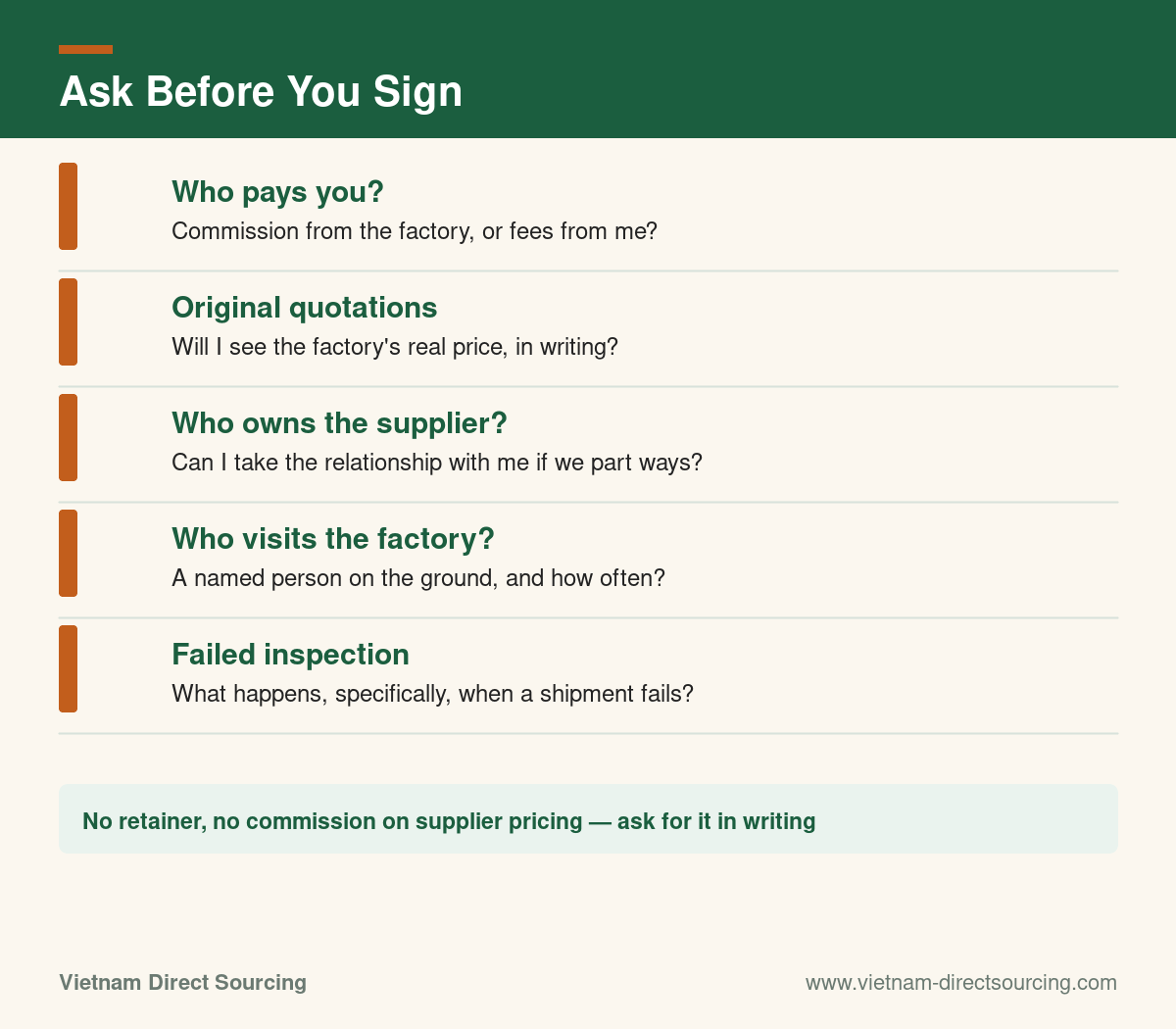
Who pays you, and how much? Will I see the original factory quotation? Do I own the supplier relationship, and can I take it with me? Who physically visits the factory, and how often? What happens, specifically, if a shipment fails inspection? Is there a retainer or minimum commitment?
The answers matter less than the willingness to answer them plainly.

The bottom line
A sourcing agent in Vietnam is not one thing. Establish who pays them before you discuss anything else, insist on seeing original factory pricing, and make sure you own the supplier relationship rather than renting it. Buy the parts of the service you actually need — and be wary of anyone who never tells you no.
Ready to get started? Vietnam Direct Sourcing is here to help. With local expertise and a trusted network of suppliers, we’ll make sure your sourcing journey is as smooth as possible.
Not sure where to start? See how our Vietnam sourcing solutions work, from supplier identification to quality assurance.
Learn more about this topic on our podcast!
Want to dive deeper into this subject? Check out our latest podcast on this subject on Spotify, where we explore this topic and so much more! Whether you're on the go or relaxing at home, tune in for insights, tips, and discussions that bring our blog topics to life.
