



How to Request an FMCG Quote from Vietnam (and Get a Real Number Back)

Most buyers who request an FMCG quote from Vietnam get three replies they cannot compare. One factory quotes ex-works per carton, the next quotes FOB per unit, and the third quotes a price that quietly assumes its own packaging. None of them are wrong — the brief was. Fast-moving consumer goods are the hardest category to quote cold, because the product is only half of what you are buying. The other half is the pack, and until the pack is specified, no number you receive means very much.
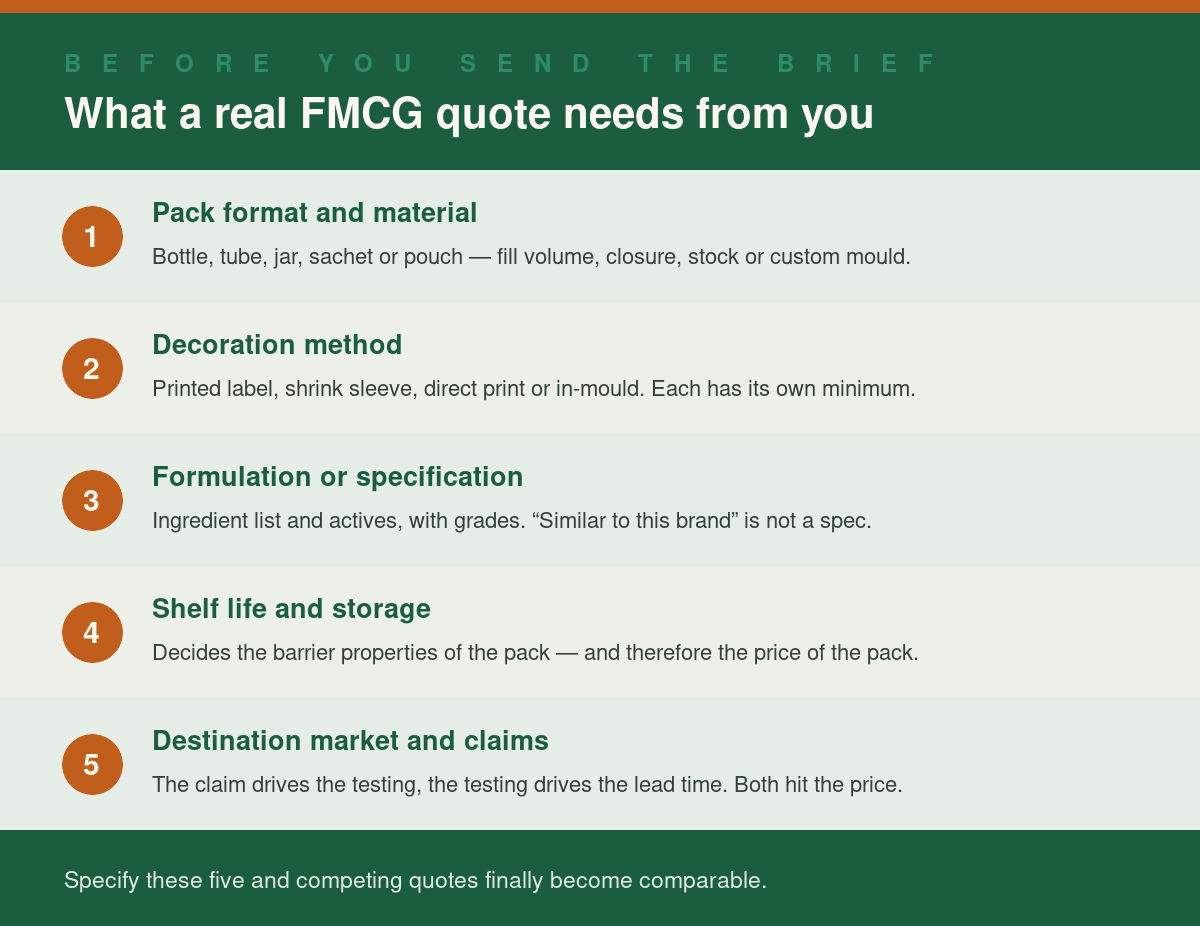
What a real FMCG quotation needs from you
In industrial Product Sourcing, a dimensioned drawing will usually get you a usable price. FMCG does not work that way. A Vietnam FMCG export quotation you can actually compare needs five things, and most enquiries arrive with two. They are set out below.
The MOQ that binds is usually the packaging
This is the most common surprise for buyers new to FMCG Supplier Sourcing in Vietnam. You ask a factory for its minimum order quantity, it says three thousand units, and you plan around that. Then the printed laminate for your pouch has a minimum run measured in linear metres, the custom bottle needs its own mould, and the carton printer has a minimum sheet count. Your real minimum turns out to be several times the filling minimum, and none of it was hidden — nobody asked.
The practical consequence is simple. Your first production run should use stock packaging wherever the brand allows it, and move to custom components once volume justifies the tooling. We would rather tell you that before you commission a mould than after.
How we connect you with wholesale FMCG suppliers in Vietnam
Supplier Identification for FMCG starts with the fill line, not the catalogue. A factory running hot-fill glass is not the factory running cold-fill HDPE, even though both will tell you they do liquids. We shortlist on the specific process your product needs, then run a Supplier Evaluation on site — and because our specialists are in Hanoi, Da Nang and Ho Chi Minh City, that means walking the floor rather than reading a company profile.
What we check: the certifications your destination market will demand, and whether they are current rather than expired; the Quality Assurance system behind them; batch records and how the factory handles a failed batch; and whether it already supplies a retailer with its own audit regime. Ethical Sourcing belongs in the same visit — labour conditions and documentation are part of the file, not a separate exercise.
OEM, private label or contract manufacturing?
Three different commercial arrangements, routinely discussed as if they were one. Picking the wrong one is how buyers end up owning a problem they thought was the factory’s.
- Private label — the factory owns an existing formulation and puts your brand on it. The fastest and cheapest route to shelf. You do not own the formula, and you rarely get exclusivity.
- OEM — you own the formulation or design and the factory produces to it, usually with tooling you have paid for. You control the product and you carry the development risk. Put tooling ownership in writing before the first sample: who paid, who owns, where it is stored, and what happens if you leave.
- Contract manufacturing — broader again. The factory buys the materials and supplies finished goods, sometimes including the regulatory file.
Most buyers ask for OEM and actually want private label for their first run. Being honest about which one you are ready for saves months.
Non-prescription pharmacy products: the gate is GMP, not price
Over-the-counter and pharmacy-shelf goods — supplements, topicals, personal care, medicated skincare — are where Vietnam is most underestimated, and where buyers most often get caught.
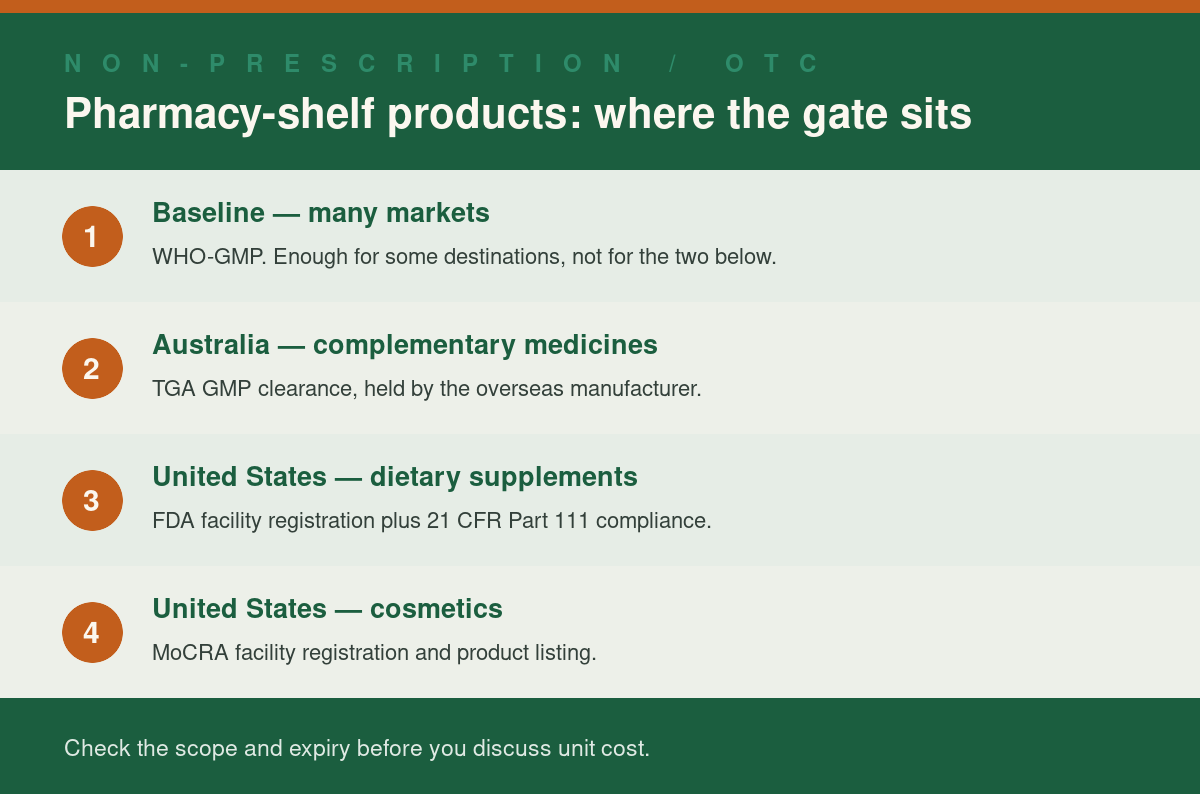
The gate is the manufacturing standard, and it sits before the price conversation. WHO-GMP will serve plenty of markets, but Australia and the United States each set their own bar, as the table below sets out. Check the certificate, its scope and its expiry before you discuss unit cost, because a factory that cannot be cleared is not cheap — it is unusable.
This is one area where our Market Research is first-hand rather than desk-based. A member of our team came to us from Pharmacity, one of Vietnam’s largest pharmacy retail chains, which means we have seen which domestic manufacturers hold up to a major retailer’s own quality audits — and which ones were delisted, and why.
What an FMCG sourcing agent in Vietnam costs
Pricing for a Vietnam sourcing agent falls into one of two models, and they are not equivalent.
- Commission — the agent takes a percentage from the factory. It looks free. It means you never see the factory’s real quote, and the agent’s income rises with your unit price.
- Fee for work — you pay for the work actually done: supplier identification, factory audits, quality control inspections, price benchmarking, production management.
We work the second way: pay as you go, no retainer, and no commission taken from suppliers, so the number you see is the factory’s own. On a first FMCG programme that matters more than usual, because the packaging and formulation decisions made in week one are the expensive ones to unwind in month six.
An Australian pharmacy wholesaler came to us holding five quotes for a private-label topical range, spread so wide they assumed some factories were cutting corners. They were not. Each had assumed a different tube size, a different closure and a different carton.
We fixed the pack specification, reissued one identical brief to all five, and the prices converged to within a few per cent. The real differences then became visible. Two of the five could not evidence current GMP clearance for the Australian market and were eliminated on that basis alone, not on price. A third was already running at capacity and would have put the buyer at the back of the queue every month. The order went to the fourth. Three weeks of work removed the only risk that actually mattered.
The bottom line
Vietnam is a strong FMCG base, and for importers diversifying away from a single-country supply chain it is one of the few places that can take a consumer product from formulation to packed carton without leaving the country. But an FMCG quote is only ever as good as the brief behind it. Specify the pack, name the destination market, check the certificates before the price, and insist on seeing the factory’s own number. If you are ready to buy wholesale FMCG products from Vietnam, that is where to start.
Ready to get started? Vietnam Direct Sourcing is here to help. With local expertise and a trusted network of suppliers, we’ll make sure your sourcing journey is as smooth as possible.
Not sure where to start? See how our Vietnam sourcing solutions work, from supplier identification to quality assurance.
Learn more about this topic on our podcast!
Want to dive deeper into this subject? Check out our latest podcast on this subject on Spotify, where we explore this topic and so much more! Whether you're on the go or relaxing at home, tune in for insights, tips, and discussions that bring our blog topics to life.



Organic Cotton, Bamboo & Hemp Fabric from Vietnam: GOTS and OEKO-TEX Explained
