




How to Find Furniture & Wood Manufacturers in Vietnam

Vietnam has quietly become the world’s furniture workshop. In 2025 its wood and wooden-furniture exports hit a record US$17.2 billion, and the United States alone took roughly US$9.5 billion of that — close to half of every wooden chair, cabinet and table America imports now comes from Vietnam. If you are a wholesaler or product owner looking to move furniture sourcing out of China, Vietnam is the obvious first stop. But finding the right partner — a genuine manufacturer, not a trading middleman — takes more than a quick search. Here is how to do it properly.
Why Vietnam for furniture
The numbers tell the story. Wooden furniture makes up around 60% of Vietnam’s US$17.2 billion wood industry, and the country’s share of the US wooden-furniture market climbed to about 45% in 2025. Behind that growth are three things buyers care about: competitive tariffs compared with China, a mature manufacturing base built over decades, and skilled labour in solid wood, plywood, rattan and upholstered pieces. For importers pursuing a China+1 strategy, Vietnam offers scale and quality in the one place.
Good Global Sourcing still starts with homework, though. The country has more than 5,000 wood-processing and furniture facilities, ranging from world-class exporters to small workshops that mainly re-sell other factories’ output. Knowing how to tell them apart is the whole game.
Start with Market Research and a clear spec
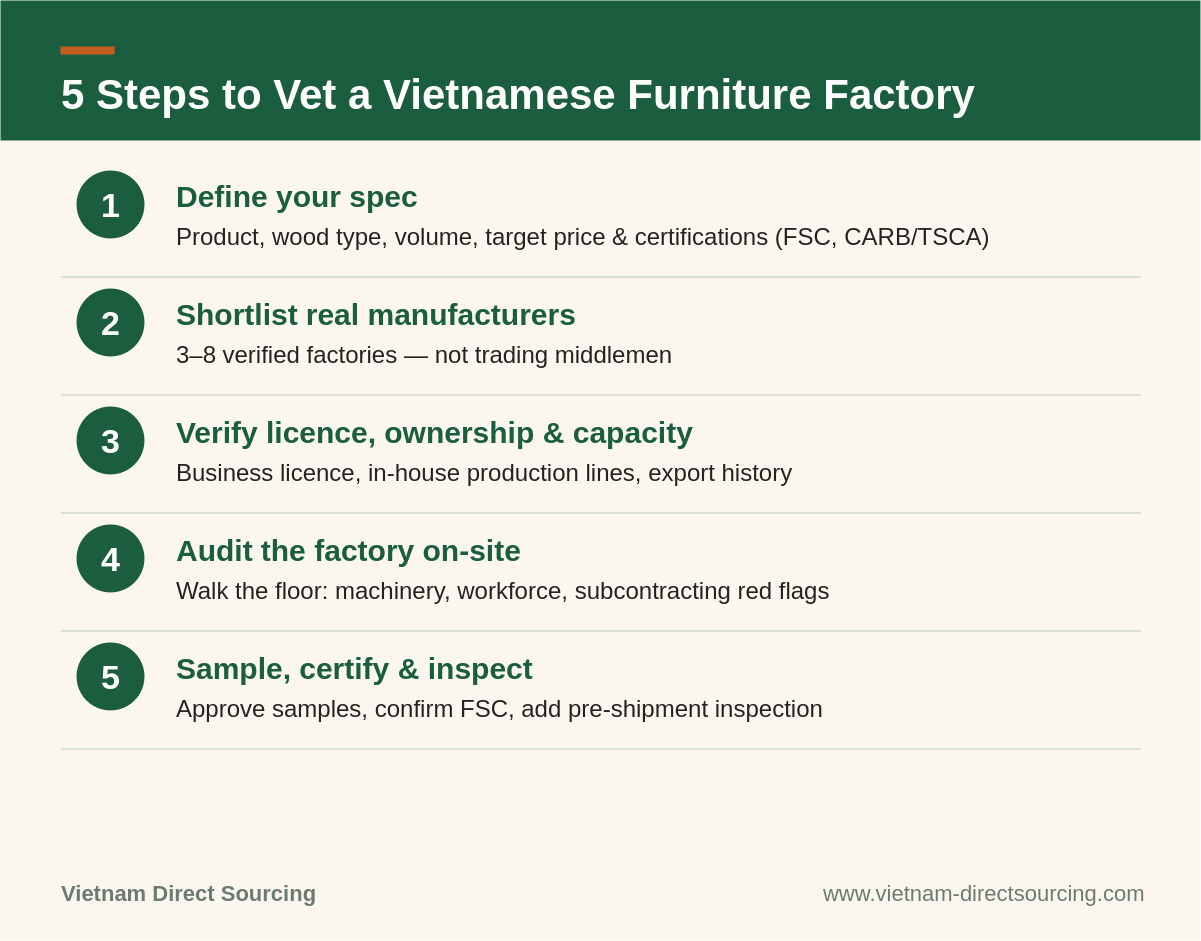
Before you contact a single factory, get specific. Are you sourcing indoor or outdoor furniture? Solid hardwood, engineered wood, rattan or metal-and-wood combinations? What are your target landed price, order volume, and destination market? Which certifications does your buyer require — FSC-certified timber, CARB/TSCA compliance for the US, or specific finish standards? A tight brief turns Product Sourcing from a fishing expedition into a targeted search, and it lets a supplier quote you accurately the first time.
Where the factories cluster
Most of Vietnam’s furniture capacity sits in the south — Ho Chi Minh City and the neighbouring provinces of Binh Duong and Dong Nai account for roughly half the industry’s value, with dense clusters of integrated exporters. Central Vietnam (around Quy Nhon) is strong in outdoor and garden furniture. Knowing the geography helps you plan factory visits efficiently and understand why quotes differ between regions.
Manufacturer or middleman? The number-one trap
The single biggest mistake importers make is paying a trader’s margin while believing they are dealing with the factory. A convincing website and a glossy catalogue prove nothing. Real Supplier Identification means verifying the business licence and registered activity, confirming the company actually owns production lines, and checking export history for your product type. The fastest test of all is a factory visit — walking the floor, seeing the machinery and workforce, and asking which items are made in-house versus subcontracted.
How to find and shortlist suppliers
Effective Supplier Sourcing combines several channels: reputable trade directories, industry expos such as VIFA in Ho Chi Minh City, referrals from freight forwarders and other importers, and — most reliably — a local partner with feet on the ground. Aim for a shortlist of three to eight verified manufacturers rather than a long list of unknowns. Quality of shortlist beats quantity every time.
Vet before you commit: Supplier Evaluation and Quality Assurance
Once you have a shortlist, evaluate before you order. A proper Supplier Evaluation covers an on-site factory audit, a capacity check against your volumes, verification of certifications at source, and a review of the factory’s own quality controls and subcontracting. Then run samples, and build in production and pre-shipment inspections as part of your Quality Assurance plan. Ethical Sourcing matters too: confirm legal timber sourcing (FSC chain-of-custody) and acceptable labour conditions, both of which your own customers increasingly ask about.
Case in point. A US homewares wholesaler wanted to shift a range of oak cabinets out of China. We ran Supplier Identification across Binh Duong and Dong Nai, shortlisted six candidates, and evaluated the two strongest on-site. One turned out to be a trader subcontracting to unknown workshops — we flagged it and moved on. The client placed a first order with the verified manufacturer, with FSC documentation confirmed and a pre-shipment inspection built in. First container shipped without a single quality claim.
The bottom line
Vietnam is the strongest furniture-sourcing market in the world right now, but the difference between a smooth supply chain and an expensive mistake comes down to verifying who you are actually dealing with. Define your spec, shortlist real manufacturers, and evaluate before you commit.
Ready to get started? Vietnam Direct Sourcing is here to help. With local expertise and a trusted network of suppliers, we’ll make sure your sourcing journey is as smooth as possible.
Not sure where to start? See how our Vietnam sourcing solutions work, from supplier identification to quality assurance.
Learn more about this topic on our podcast!
Want to dive deeper into this subject? Check out our latest podcast on this subject on Spotify, where we explore this topic and so much more! Whether you're on the go or relaxing at home, tune in for insights, tips, and discussions that bring our blog topics to life.

The 2026 Vietnam Sourcing Roadmap: 12-Month Execution Plan Before Capacity & Energy Constraints Tighten

Leave a comment
Your email address will not be published. Required fields are marked *