Supplier Due Diligence in Vietnam: A Six-Step Checklist Before You Pay
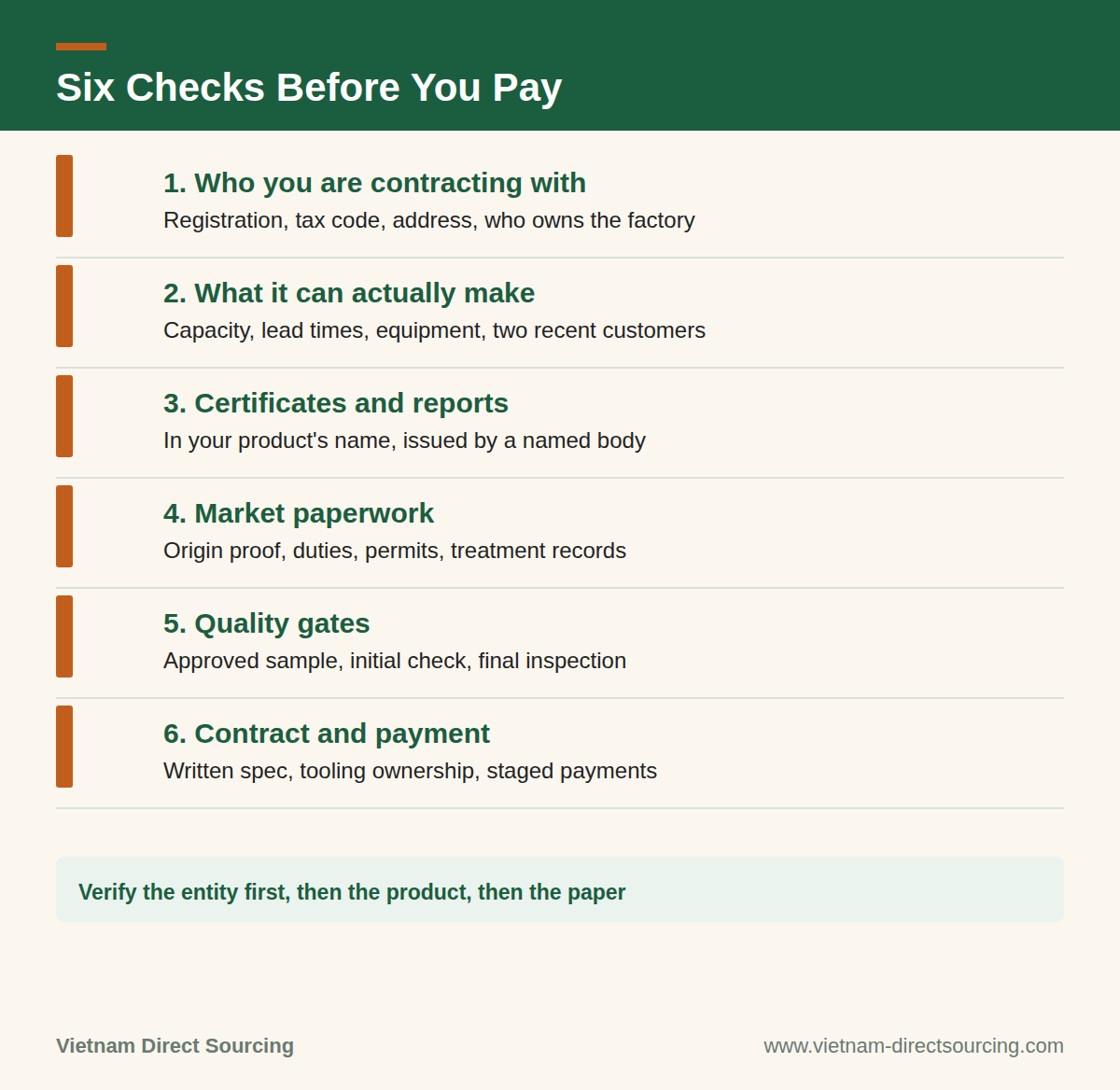
Supplier due diligence in Vietnam is the set of checks you make before you pay a deposit: who you are really contracting with, what the factory can make, which certificates are genuine, what your market needs on paper, how quality will be checked and how the money is released. Most first-time importers do not lose money on the unit price. They lose it on something they did not verify. This checklist puts the checks in the order we use them, so each step protects the next. It works for buyers in the United States, Australia, Europe and elsewhere; the market-specific paperwork in step four is where they differ.
Step 1: Check who you are contracting with
A good website is not a good factory, and a factory name on a quote is not proof that the company quoting owns it. Before you talk price, confirm the legal entity.
- Registration. Vietnam’s National Business Registration Portal (dangkykinhdoanh.gov.vn) lets you look up a company by name or enterprise code, and the basic record is public. Check that the name, enterprise code, registered address and listed business lines match the quote, the invoice header and the bank account name. Ask the supplier for a copy of the business registration certificate so you can compare it.
- Factory or trader? A trading company is not a bad partner by definition, but it adds a margin and an extra link you cannot see. Ask who operates the production lines, where they are, and whether the company that signs the contract is the company that makes the goods. If the answer is a different company, treat that company as the supplier you need to verify.
- Bank account. Pay only to an account in the contracting company’s own name. A request to pay a personal account or a third party is a stop sign, whatever the reason given.
- Ownership and related entities. Ask who owns the factory and whether any related company will be involved. It matters for duty orders that are producer-specific (see what a sourcing agent actually does for how we check this).
Step 2: Test what the factory can really make
Capacity claims in a brochure are marketing. Ask for evidence you can check.
- Capacity and utilisation. Monthly output for your product type, how much of it is already booked, and the realistic lead time for your order size. A factory that is full will either say no or subcontract your order without telling you.
- Equipment and process. The machines, moulds or lines your product needs, and which of them are in-house. Ask directly which steps are subcontracted.
- References. Two recent customers who export to markets like yours, and permission to contact them. A factory used to your market already understands your documentation and quality expectations.
- A visit or an audit. A video call shows what the factory chooses to show. A site visit by you, or by someone acting for you, is the single most valuable check in this list. Our Supplier Evaluation service is built around exactly this.
Step 3: Read certificates and test reports properly
A certificate is only useful if it is for your product, from a body you can name, and still valid.
- Management system. ISO 9001 is a reasonable baseline. Check the certificate number with the certification body, and check that the scope covers the site that will make your order.
- Social compliance. Ask your own customers which report they require before you ask the factory for one. A SMETA audit produces a report, not a certificate, and BSCI and SMETA are different systems that are not interchangeable. Ask for the actual report, its date and its scope.
- Category certificates. FSC for wood, GOTS and OEKO-TEX for textiles, food-safety certification for food contact, compostability certificates for packaging. Each must name the product or the site, show a number you can verify, and be current. For two worked examples, see our guides to organic fabric and GOTS and biodegradable packaging.
- Test reports. Ask for reports from an accredited laboratory, in the product’s name, with a recent date. A report for a different material or an old batch tells you little about yours.

Stock photo.
Step 4: Get the paperwork for your market right
This is where the checklist differs by destination, and where goods get held, taxed more than expected or refused.
- Proof of origin. If you rely on a free trade agreement, ask before you order how your supplier will prove origin for your product and your HS code. For Australia and New Zealand under AANZFTA, the route changed with the Second Protocol: Form AANZ from the issuing authority, or a declaration by an approved exporter. We explain it in The AANZFTA Upgrade.
- Duties and orders. Check the full duty position for your product, including any anti-dumping or countervailing orders, which are often producer-specific and depend on the exact company that makes the goods. Your customs broker should confirm this in writing.
- Forced-labour and traceability rules. For the United States, goods with cotton, polysilicon or other flagged inputs may need supply-chain documents under the Uyghur Forced Labor Prevention Act. Ask the factory early where its key inputs come from and whether it can document them.
- Biosecurity and permits. Australia checks timber, bamboo, plant material and wood packaging closely. Check the Department of Agriculture’s BICON import conditions for your product, and confirm the factory can supply treatment documents and ISPM 15-marked packaging where it applies. Other markets have equivalents.
- Product safety and labelling. Electrical, children’s, food-contact and chemical products carry market-specific rules. Map them before production, not at the port. Our guide to documents required for logistics in Vietnam covers the export side.
We are a sourcing company, not a customs broker or a law firm. Use this list to know what to ask, then confirm the answers with your broker for your own product.
Step 5: Build quality gates into the order
Do not scale from a promise. Put the checks in the contract and the schedule.
- Approved sample. Agree a reference sample in writing before bulk production, keep one, and tie it to a written specification. Our guide to a product specification sheet shows what to put in it.
- Initial production check. When up to 20% of the order is complete, a check of materials, process and early output catches systematic problems while they can still be fixed.
- Final pre-shipment inspection. When 80–100% is complete and before the container is loaded, an independent inspection against an agreed sampling standard and written defect limits decides whether the goods ship. Our guide to pre-shipment inspections without being on the ground explains how it works remotely.
Those are the two on-site inspections VDS field staff carry out. Inspection during production, container loading checks and independent verification are optional extras that we arrange through a quality-assurance partner when a product justifies them.
Step 6: Put the contract and payment terms in writing
- Specification and tolerances. “Make it like the sample” is not a specification. Write down materials, dimensions, tolerances, packaging, labelling and the standard the goods must meet.
- Tooling and intellectual property. If you pay for moulds, tooling or designs, state in writing that you own them, where they are kept and what it costs to move them.
- Staged payment. Avoid paying everything up front. A common structure is a deposit to start production and the balance against a passed final inspection or against the shipping documents. For larger orders, a letter of credit or an escrow arrangement ties release to performance.
- Remedies. Agree what happens if goods fail inspection, ship late or arrive damaged, and which law and forum apply. See our guide to manufacturing contracts for importers.
Red flags that should stop the order
- The company on the quote, the contract and the bank account are three different names.
- No address you can verify, or a factory that cannot be visited or audited.
- A price far below every other quote, with no explanation of materials or process.
- Certificates that are expired, cover a different site, or cannot be checked with the issuing body.
- Pressure to pay the full amount before production starts, or to a different account at the last minute.
- Reluctance to let an independent inspector in before shipment.
A worked example
This is an illustration, not a client story. An importer receives a quote from a company that describes itself as a factory. At step one, the registration lookup shows a trading company with no manufacturing business line, and the supplier admits the goods are made by another company. At step two, the importer asks to visit the real factory, which turns out to be capable and willing to contract directly. At step four, it becomes clear that the trader could not have supplied the origin paperwork in its own name. The importer contracts with the factory, pays a deposit to the factory’s own account, and releases the balance after the final inspection. None of this needed a clever tool. It needed the checks in the right order, before the money moved.
The bottom line
Due diligence in Vietnam is not a single gate but a sequence: the entity, the capability, the certificates, the paperwork, the quality gates and the contract. Most failures come from skipping one of them, usually because the price looked good. If you would rather not run the checks yourself, our sourcing solutions cover Supplier Identification, Supplier Evaluation and Quality Assurance, and our FAQ answers the questions we hear most.
Registry, certification, origin and import-condition details in this article were checked on 16 November 2026 and can change. Confirm current requirements for your product and market with the issuing body or your customs broker before ordering. This article is general information, not customs or legal advice.
Ready to get started? Vietnam Direct Sourcing is here to help. With local expertise and a trusted network of suppliers, we’ll make sure your sourcing journey is as smooth as possible.
Not sure where to start? See how our Vietnam sourcing solutions work, from supplier identification to quality assurance.
Listen to the episode
This topic is also a short episode of the VDS podcast, on YouTube and Spotify.