Moulded Pulp, Bagasse & Paper Packaging from Vietnam
Moulded pulp packaging from Vietnam is a practical alternative to plastic and foam for trays, bowls, clamshells and protective inserts. But “moulded pulp” covers several different products, and one of them is now subject to heavy US anti-dumping and countervailing duties. If you import into the United States, work out which product you are buying before you compare prices. This guide covers the product types, the US duty position, the PFAS and compostability rules that matter in Europe, the US states and Australia, and how to vet a factory. For the wider picture of eco-packaging materials and certificates, start with our guide to biodegradable and compostable packaging manufacturers in Vietnam; this article goes deeper on moulded fibre.
What counts as moulded pulp
Moulded pulp, also called moulded fibre, is made from cellulose fibre that is formed in a mould and dried. The fibre can be recycled paper and cardboard, sugarcane bagasse (the fibrous residue left after the juice is pressed), bamboo, wheat straw or virgin wood pulp. How the product is formed matters for finish, tooling cost and, as we will see, for duty:
- Wet-press or thick-wall. Rougher on both sides, thicker walls, lower tooling cost. Typical products are egg cartons, bottle trays and protective inserts for electronics and appliances.
- Transfer-moulded. Smoother than wet-press and used for lighter trays and cups.
- Thermoformed. Pressed in heated moulds into a dense, smooth, thin-walled product. This is the route for premium food service items: plates, bowls, clamshells and lids.
No fibre is “best”. Bagasse is common in food service because it is a by-product that suits hot food, but it still needs a barrier for oily or wet foods. Recycled paper suits protective packaging. The right choice depends on what goes in the pack, the market it ships to and the claims you want to make.
Why look at Vietnam
Vietnam grows sugarcane and bamboo and has a paper and packaging industry, so both the raw material and the converting skills are local. The same factory clusters that serve electronics, furniture and FMCG customers also need protective and consumer packaging, which gives buyers a choice of suppliers from small moulding workshops to larger multi-process packaging firms. We do not quote a capacity figure for the sector, because no reliable one exists for moulded fibre on its own. Treat any factory’s claimed monthly capacity as something to verify on site, not something to take from a brochure.
The US duty wall on thermoformed moulded fibre
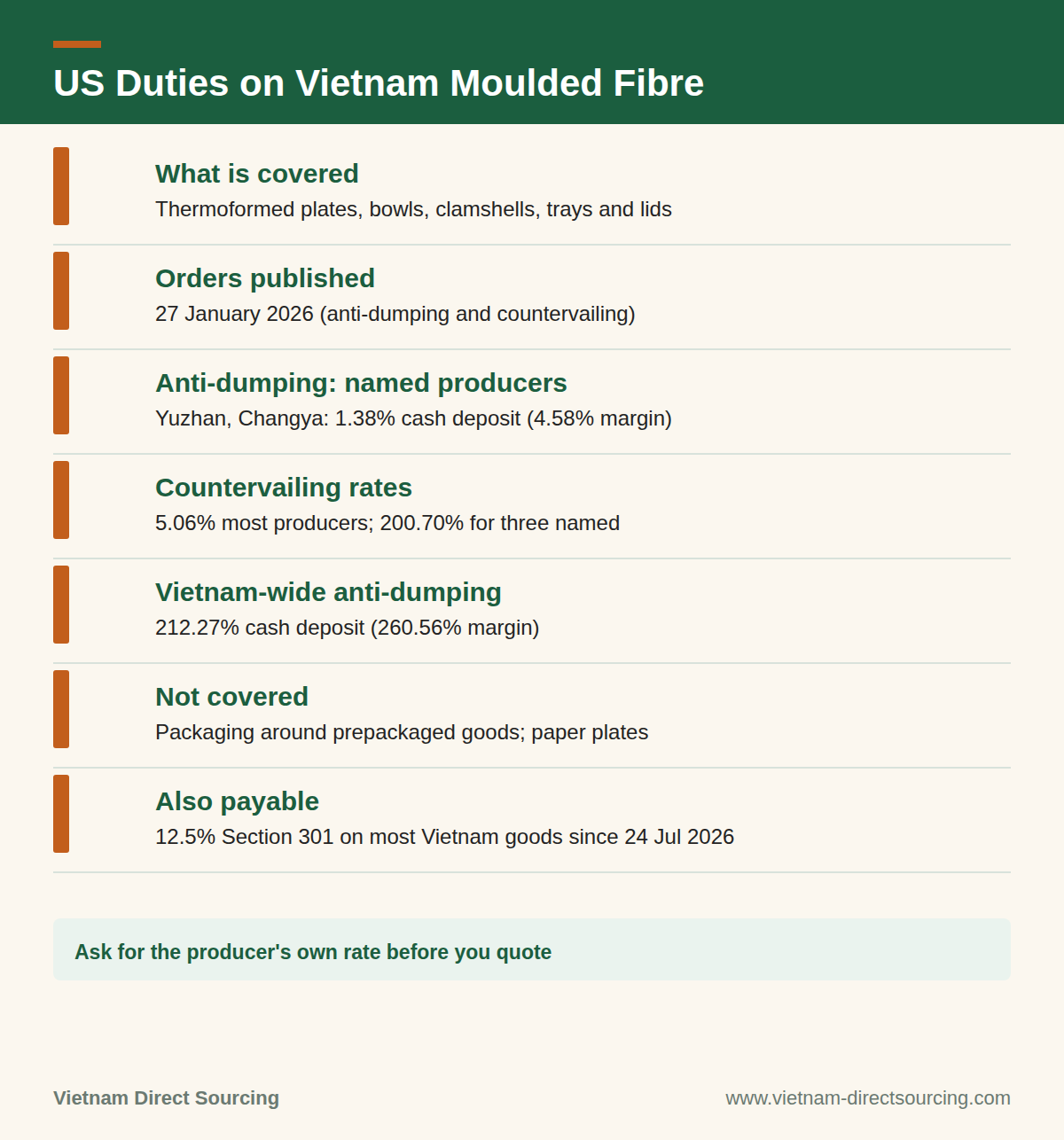
This is the part to read before you ask for a US quote. After investigations into thermoformed moulded fibre products from China and Vietnam, the US Department of Commerce issued anti-dumping and countervailing duty orders that were published on 27 January 2026 (91 Federal Register 3431 and 3437). The US International Trade Commission found that the US industry is injured by these imports, which is what allows the orders to apply.
The orders cover thermoformed moulded fibre products “regardless of shape, form, function, fiber source, or finish”, including plates, bowls, clamshells, trays, lids and other food-contact and consumer packaging, whether the fibre is virgin or recycled and whether it comes from wood, crops or agricultural residue. The fibre source is not an escape route, so bagasse, bamboo and wheat straw products are not exempt just because they are not wood. The rates in Commerce’s final determinations of September 2025 are producer-specific:
- Anti-dumping: Vietnam Yuzhan Packaging Technology and Ningbo Changya Plastic (Vietnam) each have a 4.58% margin and a 1.38% cash deposit after a subsidy offset. Producers without their own rate fall under the Vietnam-wide entity, with a 260.56% margin and a 212.27% cash deposit.
- Countervailing: 5.06% for Yuzhan and for all other producers, and 200.70% for three named producers on adverse facts (HC Packaging Asia, Honha Eco Pulp Viet Nam Paper Tray, and Pulp Tray / Martin Vietnam).
On top of these come the normal duty (zero for most moulded pulp articles under the US tariff schedule, as we read it) and the 12.5% Section 301 duty that has applied to most Vietnamese goods since 24 July 2026. Rates are producer-specific and are reviewed each year, so the most important question in your Supplier Identification is not price. It is which company makes and ships the goods, and what that company’s current rate is.
What is still open
The orders exclude two things that matter to importers. First, moulded fibre packaging that encloses or surrounds other merchandise that is prepackaged for sale, such as the packaging around a mobile phone. Second, paper plates that are already covered by separate paper plate orders. Beyond those exclusions, the scope is defined by the thermoforming process and by dense, smooth products, not by a list of items.
That leaves a grey area. Wet-press egg cartons and protective inserts are generally rougher and less dense than thermoformed tableware, but Commerce does not publish a product-by-product list, and the HTS codes in the order (4823.70.0020 and 4823.70.0040, among others) are for convenience only. If your product sits near the line, get your customs broker’s view in writing, and if the stakes justify it, ask Commerce for a scope ruling before you ship. Do not rely on a factory telling you the product is “not covered”.
Other markets and the rules that bite
The US orders do not apply to Europe, Australia or New Zealand. Those markets have their own checks, and the most important one is PFAS, the “forever chemicals” that have often been used to make fibre packaging resist grease and water.
- European Union. Since 12 August 2026, the Packaging and Packaging Waste Regulation (Regulation (EU) 2025/40) limits PFAS in food packaging: 25 ppb for any individual PFAS and 250 ppb for the sum of PFAS measured by targeted analysis (both excluding polymeric PFAS), and 50 ppm for total PFAS including polymeric PFAS. The limits apply to packaging first placed on the EU market after that date, and the Commission has confirmed there is no extra sell-off period. Moulded fibre is among the products most affected.
- United States. Several states restrict intentionally added PFAS in food packaging, including California and Maine, and New Jersey has enacted a ban that starts in January 2028. FDA clearance of a coating does not answer the state question, so ask for a PFAS declaration and a test report for any grease-resistant product.
- Australia and New Zealand. A “compostable” claim should be backed by certification to AS 4736 (industrial composting) or AS 5810 (home composting). The Australasian Bioplastics Association runs the AS 4736 scheme: ask for the licence number, and check that the certificate covers the specific product, not just the raw material. Qualifying goods can enter duty-free under AANZFTA or RCEP with the right origin paperwork; see our guide to AANZFTA, CPTPP and RCEP.
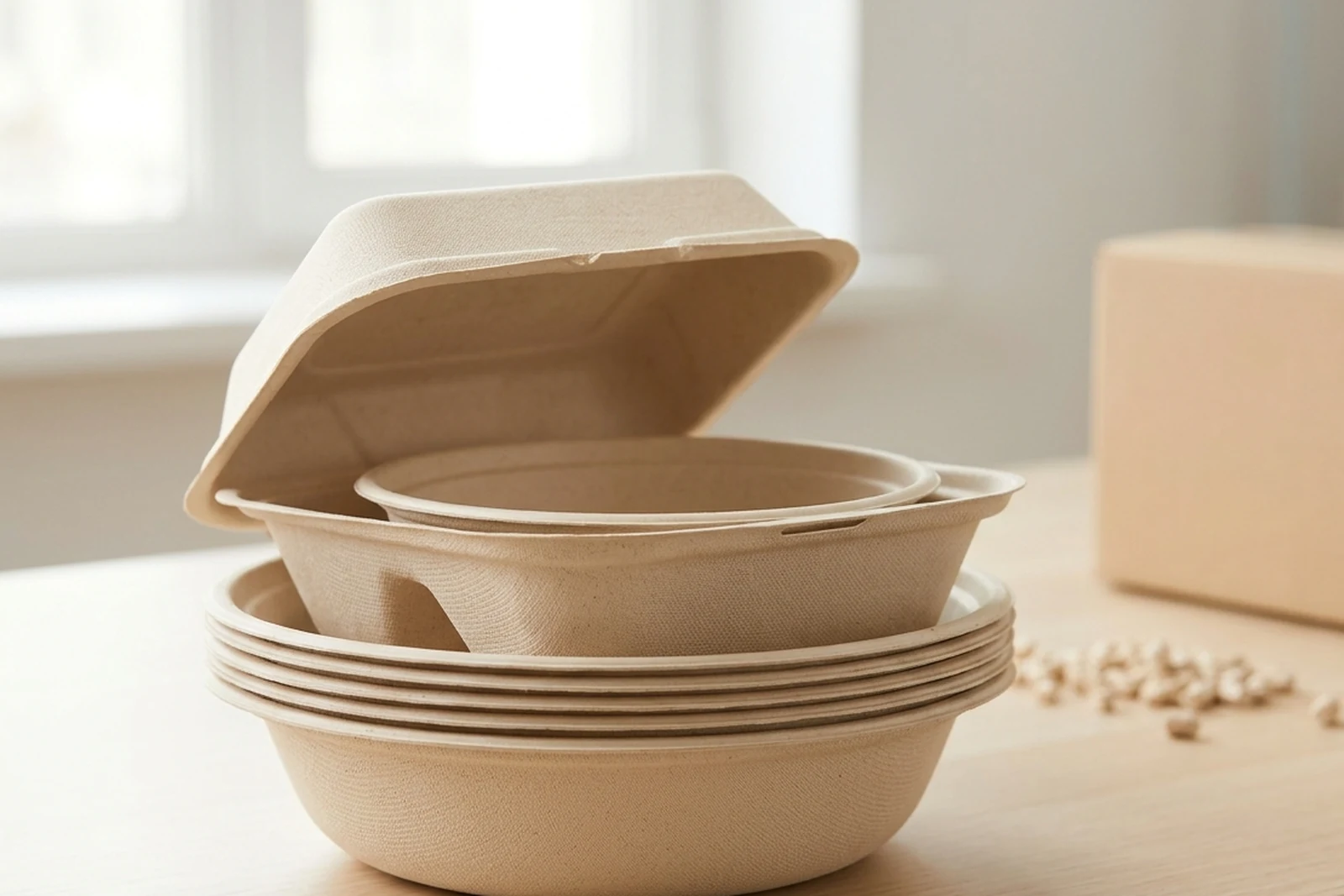
Illustration (AI-generated image).
What to ask a moulded pulp factory
- Which process and which fibre? Wet-press, transfer-moulded or thermoformed, and bagasse, bamboo, wheat straw or recycled paper. This decides your duty position for the US and your price.
- Who owns the tooling? Moulds are the main upfront cost and the reason for most minimum order quantities. Get written ownership of the moulds, the drawings, the lead time for a replacement and the cost, before you pay for them. See our guide to minimum order quantities in Vietnamese factories.
- How is it made grease- and water-resistant? Ask for the barrier method and a PFAS test report from an accredited laboratory. A total-fluorine screen is the usual first step.
- Food-contact test report. Ask for a migration test report for the destination market, in the product’s name and from an accredited lab.
- Compostability certificate. A certificate in the product’s name, with a licence number you can check, not a logo on a brochure.
- Moisture and mould. Fibre packed damp and shipped in a hot container can grow mould. Ask for the moisture specification and the packing method.
- Dimensions, stacking and strength. Nesting and stack height decide how many units fit in a container, and a compression or drop test should back any protective claim.
- For the US: the producer’s rate. The exact company name on the commercial invoice and its current anti-dumping and countervailing rates.
Two on-site checks catch most of this. At the initial production check, when up to 20% of the order is complete, we confirm the process, materials and moisture. At the final pre-shipment inspection, when 80–100% is complete, we check dimensions, finish, strength and packing before the container is loaded. For packaging pricing and what a usable quote contains, see our guide to requesting an FMCG quote from Vietnam.
A worked example
This is an illustration with made-up prices, not a client story. A US food service distributor asks for 100,000 bagasse clamshells and the customs value is US$5,000 (US$0.05 each). The normal duty is assumed to be zero.
- Producer with its own rate (for example 1.38% anti-dumping and 5.06% countervailing): 6.44%, plus 12.5% Section 301, is 18.94%. Duties are about US$947, so the landed cost is about US$5,947.
- Producer with no rate of its own (Vietnam-wide anti-dumping of 212.27%, 5.06% countervailing and 12.5% Section 301): 229.83%. Duties are about US$11,492, so the landed cost is about US$16,492.
The two quotes can look identical on the page, and the landed cost is nearly three times higher in the second case. An Australian buyer of the same clamshells would not face the US orders, and would spend that effort on PFAS reports and the AS 4736 certificate instead.
The bottom line
Vietnam is a sensible place to source moulded pulp, bagasse and paper packaging, but you need to know the product type before you quote. For thermoformed products going to the United States, the anti-dumping and countervailing orders are the first thing to check, and the producer’s own rate decides the cost. For other markets, PFAS limits and certification matter more than duty. Our sourcing solutions cover Supplier Identification, Supplier Evaluation and Quality Assurance for this category.
Duty rates, scope and regulatory limits in this article were checked on 11 November 2026 and can change. Confirm the current rate for your supplier and product, and the current rules for your market, before ordering. This article is general information, not customs or legal advice.
Ready to get started? Vietnam Direct Sourcing is here to help. With local expertise and a trusted network of suppliers, we’ll make sure your sourcing journey is as smooth as possible.
Not sure where to start? See how our Vietnam sourcing solutions work, from supplier identification to quality assurance.
Listen to the episode
This topic is also a short episode of the VDS podcast, on YouTube and Spotify.




How to Source Solar & Renewable Energy Products from Vietnam
