How to Source Solar & Renewable Energy Products from Vietnam
Vietnam has become a major base for solar manufacturing, and it is also the product category where getting your Product Sourcing wrong can cost you several times the value of the goods. If you are buying renewable energy products out of Vietnam for the United States, the duty position matters more than anything else in this article, so we will deal with it first. For almost every other product and every other market, the picture is much more open.
Vietnam’s place in renewables
Vietnam’s solar industry grew quickly over the past several years, much of it through factories owned by global and Chinese manufacturers alongside domestic firms. The scale explains the trade action. According to BloombergNEF, four countries — Cambodia, Malaysia, Thailand and Vietnam — supplied about 77% of US solar panel imports in 2024, and US manufacturers petitioned for duties on all four. The same factories make more than modules, and the wider clean energy supply chain, from racking and cable to enclosures and fabricated steel, is where many buyers will find the best opportunities.
The US duty wall: read this before you quote
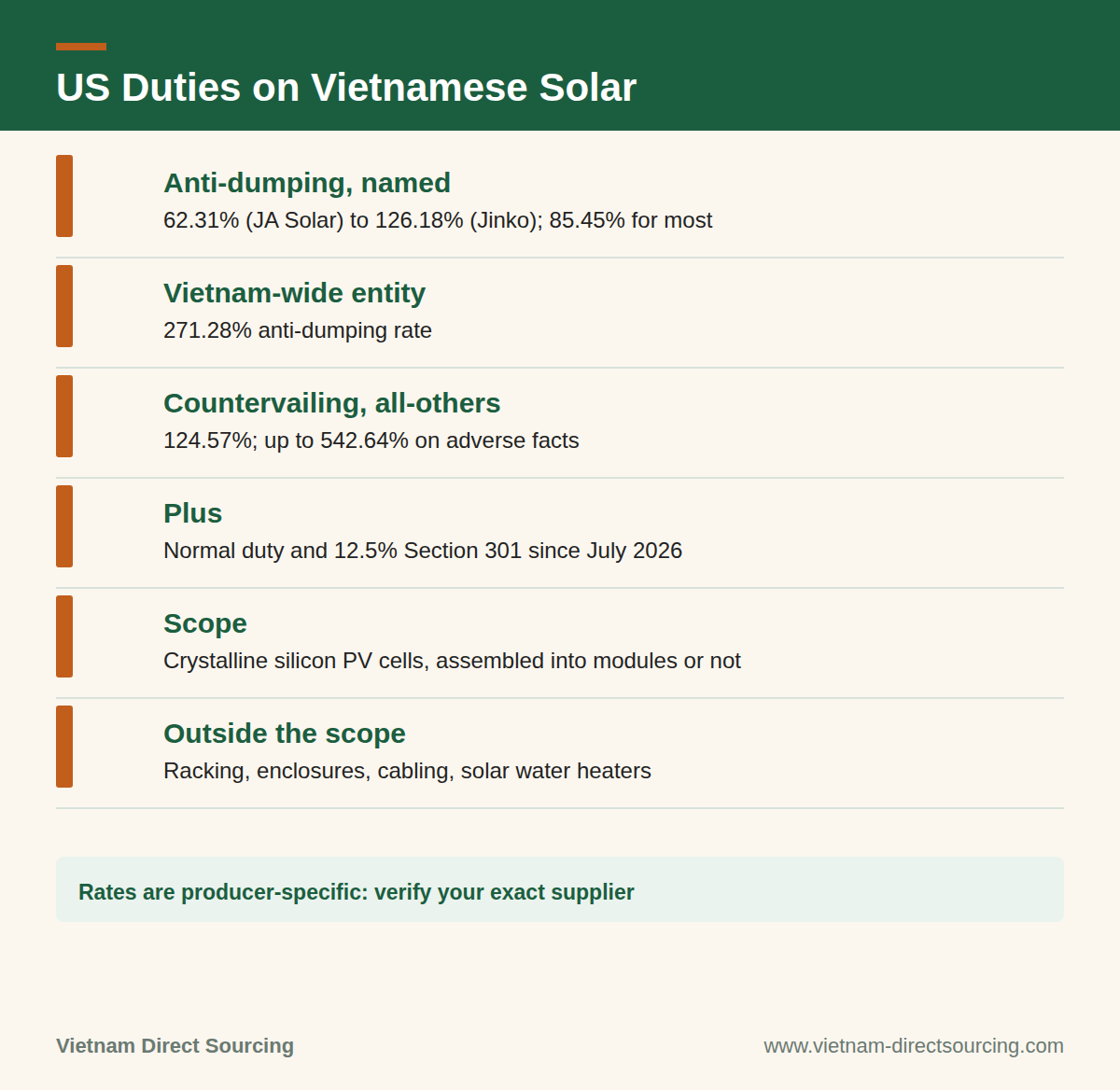
In April 2025 the US Department of Commerce issued final determinations in its anti-dumping and countervailing duty investigations into crystalline silicon photovoltaic cells from Vietnam, whether or not assembled into modules. The US International Trade Commission voted in favour of the domestic industry in May, and the anti-dumping orders were published on 24 June 2025. Rates differ by producer:
- Anti-dumping (amended June 2025): 62.31% for JA Solar and 126.18% for Jinko Solar, 85.45% for the other named producers, and 271.28% for the Vietnam-wide entity. Cash deposits are slightly lower after a subsidy offset, for example 79.92% for most of the named producers.
- Countervailing (April 2025): 68.15% for JA Solar, 230.66% for Boviet Solar, 124.57% for all other producers, and 542.64% for four producers on adverse facts.
For many producers the two duties together exceed 200% of the value of the goods, and on top of that comes the normal duty and the 12.5% Section 301 duty that applies to Vietnamese goods generally since July 2026. Rates are producer-specific and administrative reviews can change them, so the most important question in your Supplier Identification is not price. It is which company the goods are made and shipped under, and what that producer’s current rate is. A producer that cannot show it has its own rate is treated as part of the Vietnam-wide entity at 271.28%.
What is still genuinely open
The orders cover PV cells and modules. Much of the rest of the renewable energy supply chain sits under different tariff codes and different trade measures, and that is where most clean energy manufacturing in Vietnam is open to importers:
- Mounting systems and racking — ground-mount, roof-mount and ballasted systems, largely aluminium and galvanised steel.
- Aluminium frames and extrusions — for module assembly or structural use.
- Junction boxes, connectors and cabling — DC cable, MC4-type connectors and combiner boxes.
- Inverter and battery enclosures — sheet metal and composite housings with IP-rated seals.
- Solar water heaters and solar lighting — complete consumer and municipal products.
- Wind-tower and structural components — fabricated sections and flanges, drawing on the same metals base described in our steel and metal fabrication guide.
One caution for US-bound metal products. Section 232 duties on steel, aluminium and copper content apply whatever the country of origin, and the rules were reorganised in April and June 2026. For racking and extrusions headed to the United States, the metal content can cost you much of Vietnam’s advantage, so confirm which tier your product falls in before you quote.
Other markets
The US measures do not apply to Europe, Australia or Japan, so an importer in one of those markets can look at Vietnamese modules and components on ordinary commercial terms. For Australia and New Zealand, qualifying goods can enter duty-free under AANZFTA or RCEP with the right origin paperwork. See our guide to AANZFTA, CPTPP and RCEP. If your customers rely on Australian small-scale incentives, check that the modules appear on the Clean Energy Council approved list before you order.
Origin documentation
The 40% transshipment duty that applied to goods routed through Vietnam fell in February 2026 along with the other emergency tariffs, but origin has not stopped mattering. For solar cells and modules, which duty order applies depends on where the cell was made, not just where the module was assembled, and US authorities can and do investigate circumvention. Ask for a Certificate of Origin through Vietnam’s eCoSys system, and for modules, ask for documents showing where the wafer and the cell were made. Where goods pass through a third port, a Certificate of Non-Modification helps.
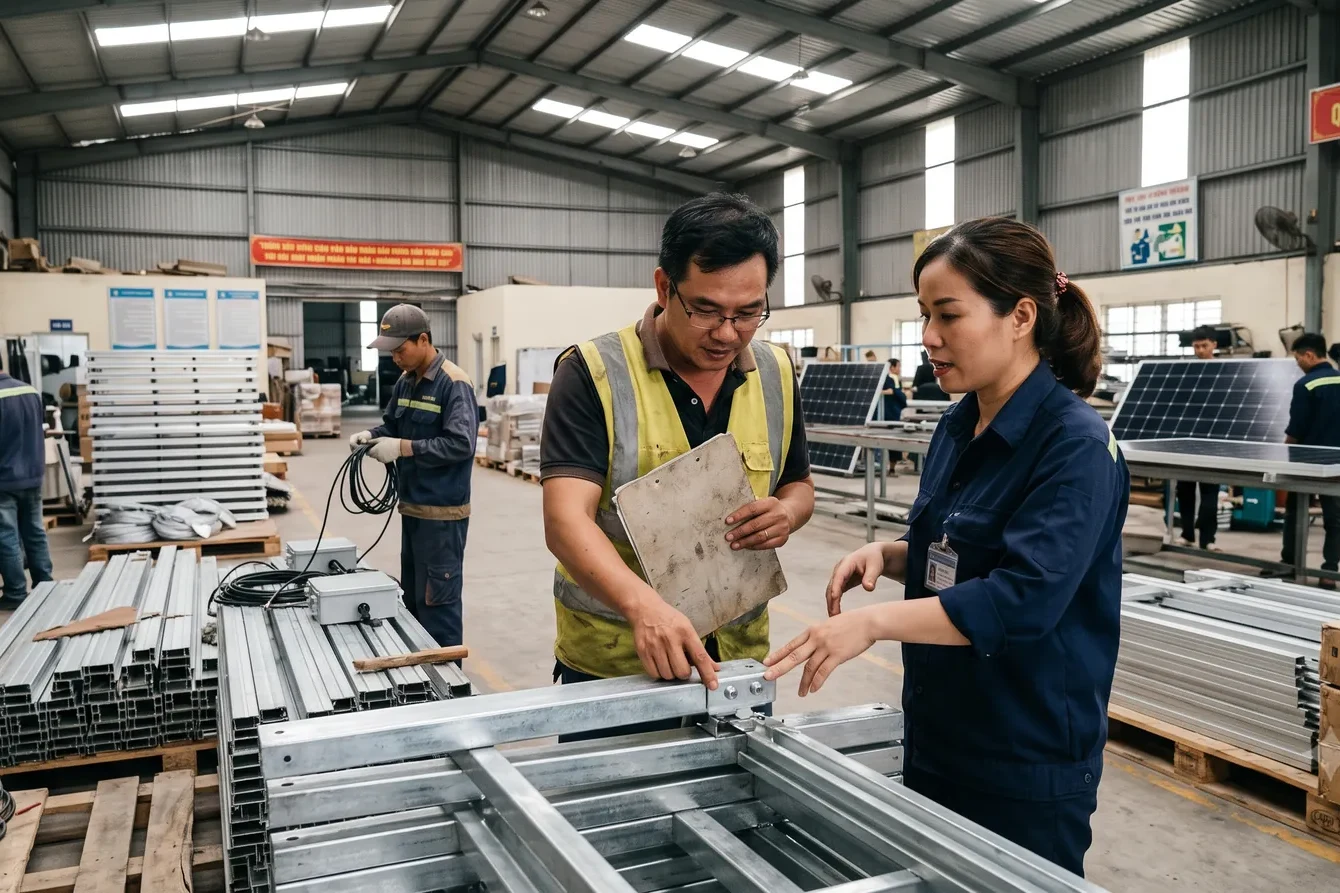
Illustration (AI-generated image).
Technical vetting
For modules, confirm IEC 61215 for design qualification and IEC 61730 for safety, tested by an accredited laboratory. For racking sold into Australia or New Zealand, wind loading to AS/NZS 1170 is not optional and should be backed by an engineer’s certification. For anything near the coast, ask for the corrosion class and the salt-spray hours of the coating.
Then ask the commercial question that catches people out: who honours the warranty, and from where? A 25-year performance warranty from a company that does not trade in your market is a marketing document, not a warranty.
A worked example
This is an illustration, not a client story. An Australian solar wholesaler wants prices on both modules and racking from Vietnam. Modules are straightforward, because the US duty orders do not apply to Australia, so Supplier Evaluation focuses on IEC certification, cell origin and warranty backing. Racking is where the value may sit: a Vietnamese fabricator working from the same metals base can offer engineering to AS/NZS 1170 and a marine-grade coating specification. Because the compliance path for racking is shorter, it is often the sensible product to move first.
The bottom line
Vietnam is a major renewables manufacturer and a genuinely good source of racking, enclosures, cabling and complete solar products. For cells and modules headed to the United States, the anti-dumping and countervailing duties are severe and producer-specific, so verify the exact rate for the exact supplier before you quote a customer. For every other market, and for non-cell components, the opportunity is real. Document your origin position properly and test the certifications at source. Our sourcing solutions cover Supplier Identification, Supplier Evaluation and Quality Assurance for this category.
Duty rates and tariff positions in this article were checked on 26 October 2026 and can change quickly. Always confirm the current rate for your supplier and product before ordering.
Ready to get started? Vietnam Direct Sourcing is here to help. With local expertise and a trusted network of suppliers, we’ll make sure your sourcing journey is as smooth as possible.
Not sure where to start? See how our Vietnam sourcing solutions work, from supplier identification to quality assurance.
Listen to the episode
This topic is also a short episode of the VDS podcast, on YouTube and Spotify.