Manufacturing in Vietnam vs China: Cost, Tariffs and Risk in 2026
A year ago, the case for moving production from China to Vietnam was mostly a tariff story, and a simple one. In 2026 it is no longer simple. The US Supreme Court struck down the emergency tariffs in February, new duties arrived in July, and several decisions are still pending. The honest answer to “Vietnam or China?” now depends on what you make, where you sell it and how well you can document where it came from. This guide sets out where things stand, and how to decide.
The short answer
- For US-bound goods, the tariff gap has narrowed but not closed. It is now mostly the older Section 301 duty on products that sit on the original China lists. For products that are not on those lists, the two countries now pay the same new duty.
- For Australia, the EU and the UK, tariffs are rarely the deciding factor. Both countries have trade agreements with these markets, so origin documents and supply chain risk matter more.
- Labour costs are lower in Vietnam, but the real factory-floor gap is smaller than the headlines suggest, and it is closing as Vietnamese wages rise.
- China is still stronger for complex products, fast prototyping and deep component supply. Vietnam is stronger for labour-intensive assembly, furniture, textiles, footwear and for buyers who want a second source.
US tariffs: where things stand
This is the part that has changed most, so here is the sequence, as at 26 October 2026.
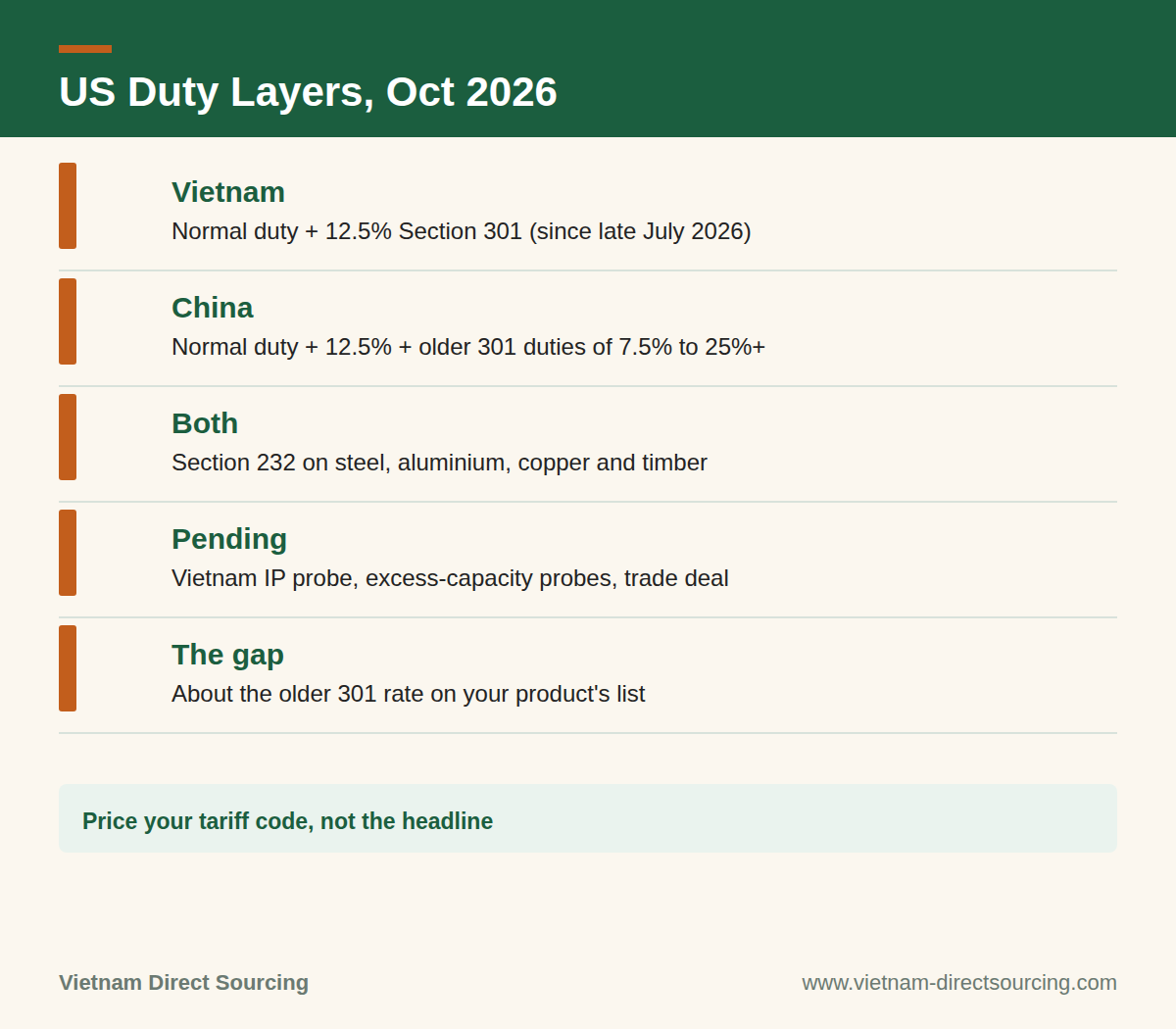
- 20 February 2026 — the Supreme Court ruled that the emergency (IEEPA) tariffs were unlawful. That removed the 20% rate that applied to Vietnam, the 40% transshipment rate and the equivalent layers on China.
- February to July — a temporary 10% Section 122 surcharge applied to imports from most countries for its 150-day limit.
- Late July — it was replaced by Section 301 duties of 10% or 12.5% on 60 economies, over a forced-labour finding. Vietnam and China both sit in the 12.5% band. Unlike the Section 122 surcharge, this duty has no end date.
- China, in addition — the older 2018–2019 Section 301 duties remain: 25% on the first three lists, 7.5% on List 4A, and higher rates on some products.
- Both countries — Section 232 duties on steel, aluminium, copper and timber products apply whatever the origin.
Pending, and worth watching: a separate Section 301 investigation into Vietnam’s intellectual property protection (opened 29 May 2026), investigations into excess manufacturing capacity that name both countries, a US–Vietnam trade agreement that both governments describe as close but unsigned, and a possible extra 7.5% duty on China that has been reported as under consideration. Importers who paid the earlier emergency duties may be entitled to refunds, and your customs broker can advise on the process.
What that means for your product
Take the same product made in either country. If it sits on a List 3 Chinese tariff line at 25%, the Chinese route pays 25% plus 12.5% and the Vietnamese route pays 12.5%: a 25-point gap in Vietnam’s favour. If it is on List 4A at 7.5%, the gap is 7.5 points. If it is on none of the lists, both routes pay the same 12.5% and tariffs no longer separate them. That is why a headline figure tells you very little, and why we price your actual tariff code, not a country average.
Other markets: a different picture
Australia is the clearest example. Goods from Vietnam can enter duty-free under AANZFTA, RCEP or CPTPP when they meet the origin rules. Goods from China can also enter duty-free under the China–Australia free trade agreement and RCEP. For many products, the tariff is therefore not what decides it, and the question becomes which supply chain you trust and which origin paperwork you can stand behind. Our guides to AANZFTA, CPTPP and RCEP and AANZFTA duty-free access explain the rules of origin.
In the EU and the UK, Vietnam has the advantage of a trade agreement with each, with duties phasing down on most products. China does not, so Chinese goods generally pay the standard rate. The phase-in schedule varies by product, so check the line that applies to yours.
Labour and operating costs
Wages are where the cost case for Vietnam started. The monthly minimum wage in Shanghai is RMB 2,740, about US$378. The highest Vietnamese minimum, Region I, rose to VND 5.31 million in January 2026, about US$202. A further rise averaging 7.8% has been proposed for January 2027. Those are legal floors, not factory pay. Real wages depend on location, skills and overtime, so be wary of any single percentage claim. What we can say is that the gap is real, it is narrower than it was, and it is narrowing as Vietnamese wages climb.
Supply chains: China’s depth, Vietnam’s dependence
China’s greatest advantage is its supplier ecosystem: components, tooling, materials and sub-contractors within a few hours of each other. Vietnam is still building that depth. In the first seven months of 2025, about 40% of Vietnam’s imports came from China, mainly electronic parts, machinery and textile inputs. In practice, many Vietnamese factories assemble components made in China.
That matters for two reasons. It limits the supply chain diversification you actually get, and it affects origin. A product that is only lightly assembled in Vietnam may not qualify for the origin you are claiming. Ask every supplier for the origin of the main components, and see our guide to rules of origin under the AANZFTA upgrade.
Quality, scale and speed
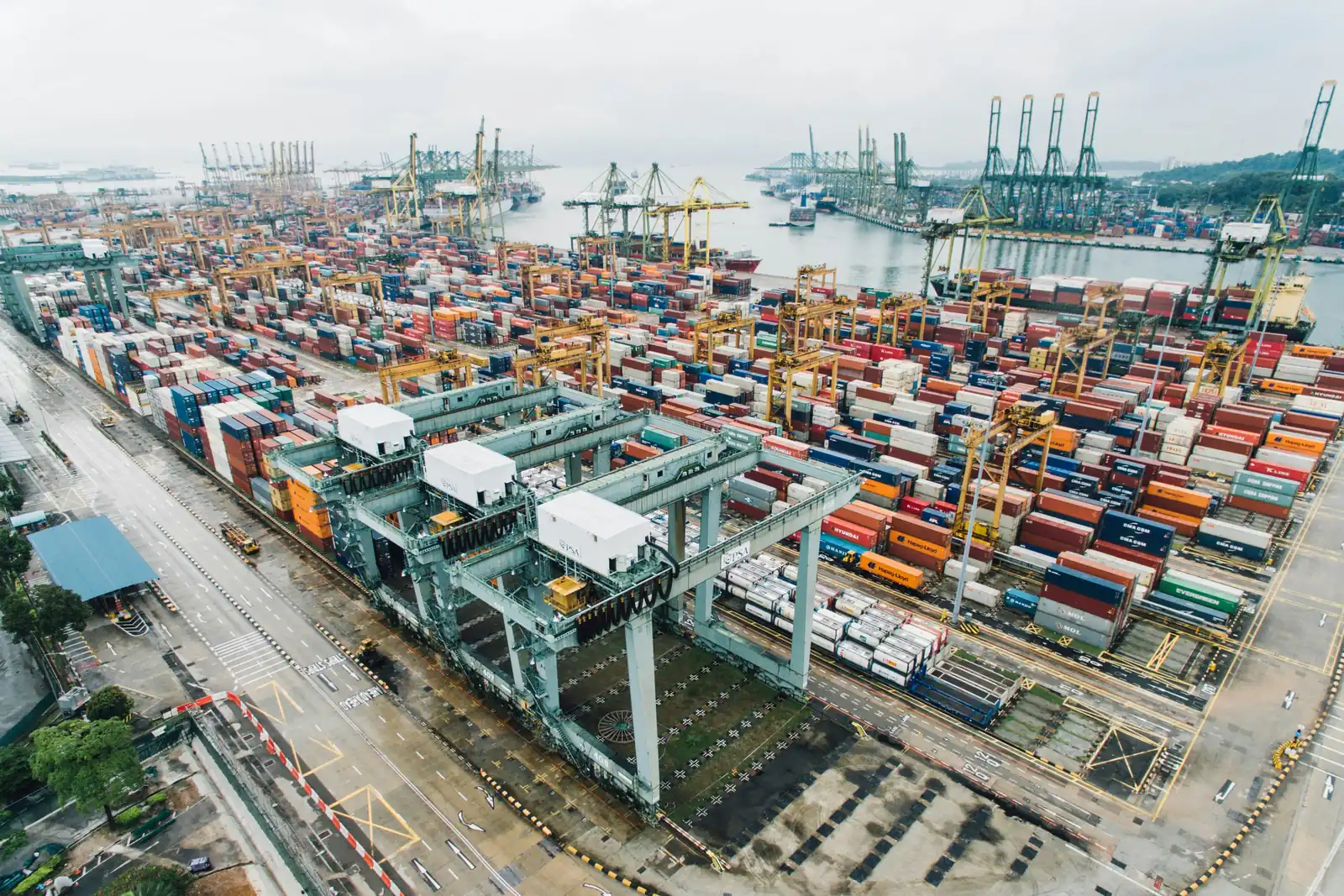
China has the edge on complex tooling, rapid prototyping and very high volumes. Vietnam is strongest in labour-intensive assembly, and its electronics base is growing. Plan for longer lead times on a first order in Vietnam, because sampling, tooling and approvals take time. Power supply and port capacity can be constraints in some clusters, so ask about backup power and shipping schedules. Whichever country you choose, a written specification and a pre-shipment inspection do more for quality than the choice of country. See our guides to the specification sheet and pre-shipment inspections.
How to choose
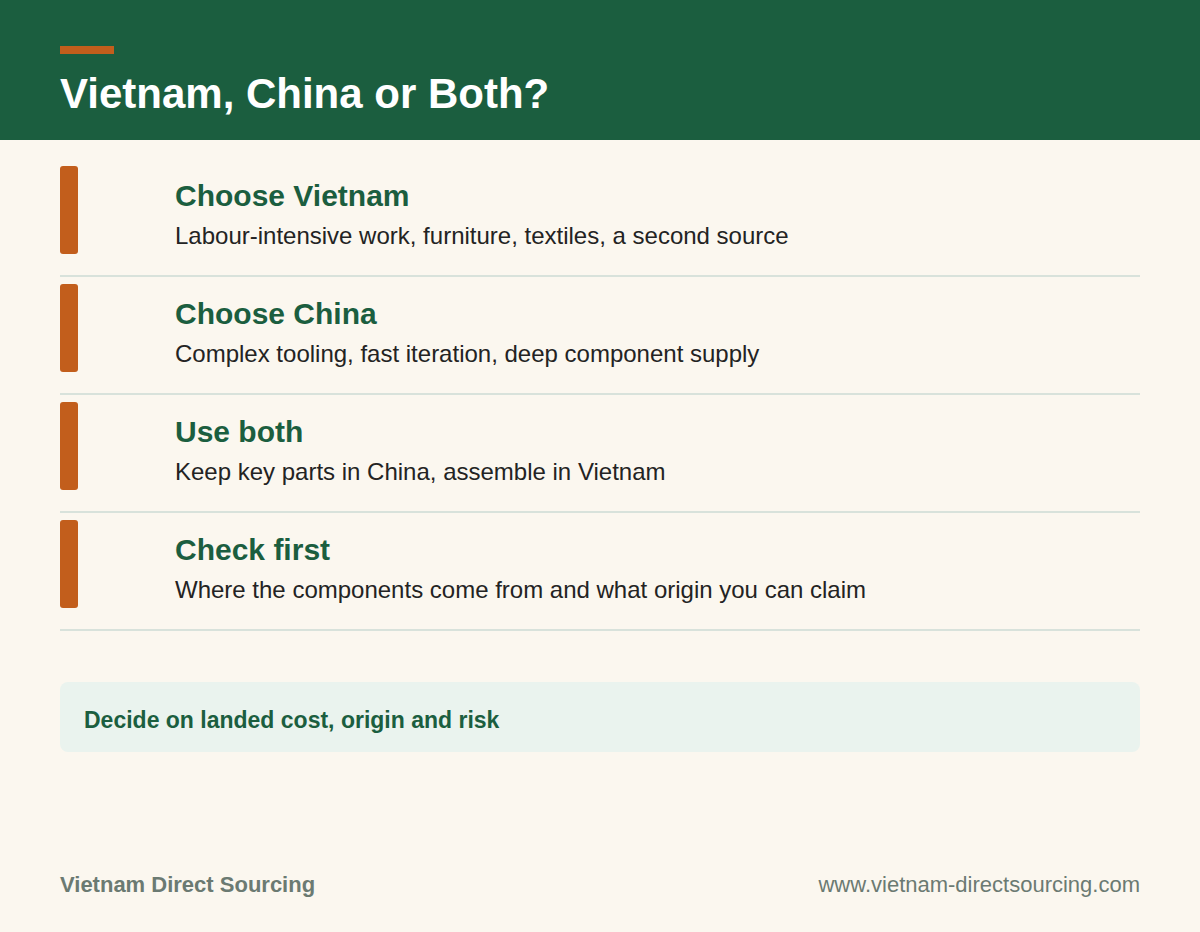
- Choose Vietnam when the work is labour-intensive, when your product is on a Chinese tariff list, when you sell into the EU or UK, or when you want a second source.
- Choose China when you need complex tooling, fast iteration or a deep component base, and the duty difference is small.
- Use both when you want to keep critical components in China and move final assembly to Vietnam, but get the origin position checked first.
What to do next
- Price your tariff code in both countries, with the current duties, not last year’s.
- Build a full landed cost. Our landed cost guide shows how.
- Ask for the bill of materials and its origin before you commit.
- Run a pilot order and inspect it.
- Review the position every quarter. The rules are moving. Our 2026 sourcing roadmap sets out the planning timeline.
The bottom line
Vietnam is still a strong second base and, for many products, a better first one. But the tariff advantage is now narrower, product-specific and subject to change, so the decision has to be made on landed cost, origin and risk rather than on a single headline. If you want a line-by-line comparison for your product, our sourcing solutions start with Market Research and Supplier Identification.
Tariff positions and rates in this article were checked on 26 October 2026 and can change quickly. Always confirm the current position for your product before ordering.
Ready to get started? Vietnam Direct Sourcing is here to help. With local expertise and a trusted network of suppliers, we’ll make sure your sourcing journey is as smooth as possible.
Not sure where to start? See how our Vietnam sourcing solutions work, from supplier identification to quality assurance.
Listen to the episode
This topic is also a short episode of the VDS podcast, on YouTube and Spotify.