






How to Find Biodegradable & Compostable Packaging Manufacturers in Vietnam
Sustainable packaging is no longer a nice-to-have. With single-use plastic rules tightening across the US, EU, UK and Australia — and shoppers actively rewarding brands that drop plastic — importers are hunting for compostable alternatives that actually perform. Vietnam has become one of Asia’s strongest sources of biodegradable packaging, from sugarcane-fibre tableware to plant-based films. Here is how to find a genuine manufacturer that can meet your specs, certifications and volumes — and avoid the greenwashing that is rife in this category.
Why Vietnam for eco packaging
Vietnam pairs a huge sugarcane industry (the raw material for bagasse) with a fast-growing bioplastics sector, and it already exports sustainable packaging to the EU, US and Japan at a real cost advantage. For importers running a China+1 Global Sourcing strategy, it is a natural fit. The catch: compostable capacity is still developing, and some factories quietly rely on imported resins rather than genuine bio-feedstock — which makes Supplier Evaluation essential.
Know your materials (and the correct terms)
“Biodegradable”, “compostable” and “bioplastic” are not interchangeable, and getting the terminology right is the first step in good Product Sourcing:
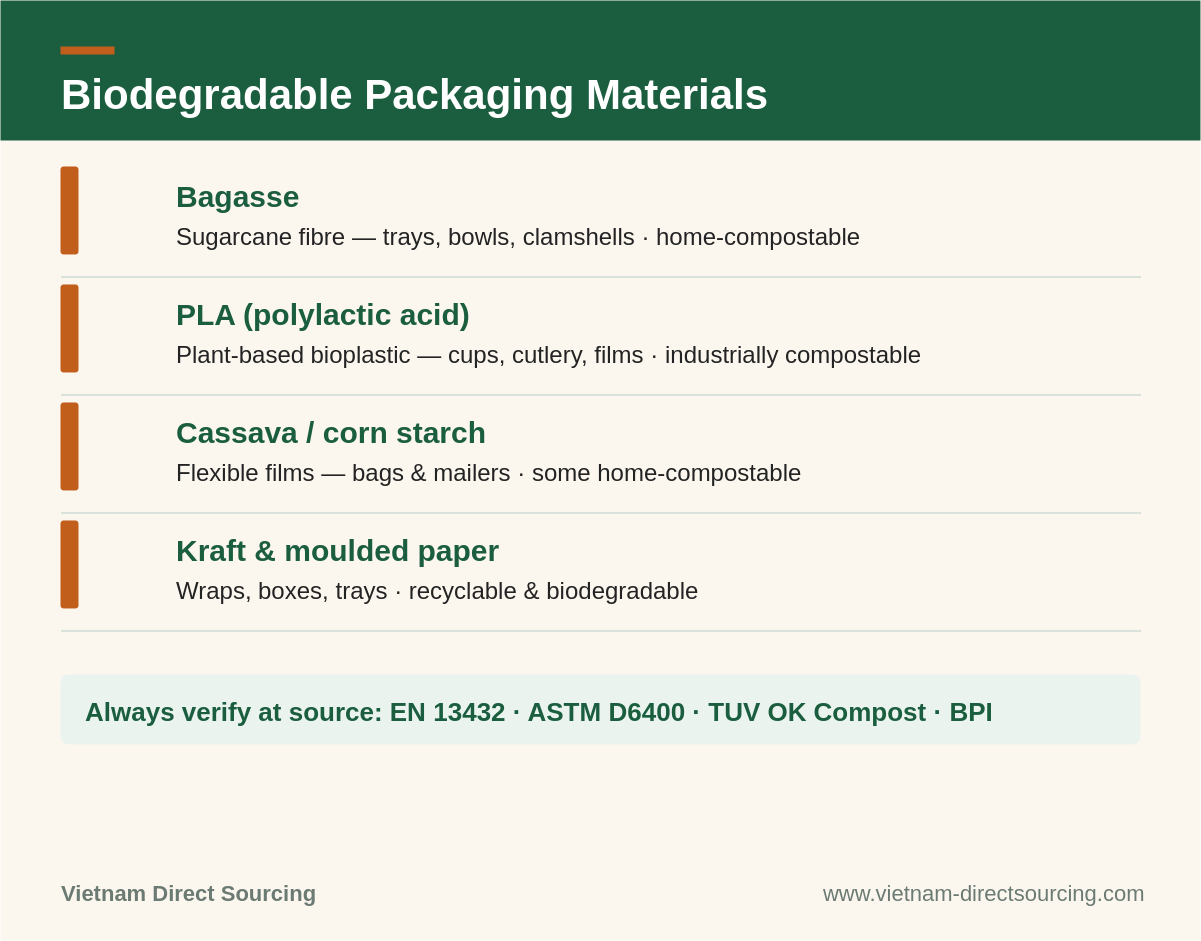
- Bagasse — sugarcane fibre left after juice extraction; moulded into trays, bowls, plates and clamshells. Sturdy, home-compostable, food-safe.
- PLA (polylactic acid) — a bioplastic made from plant starch (corn/cassava); used for cups, cutlery, films and lids. Industrially compostable.
- Cassava / corn starch blends — flexible films and carrier bags; some are certified home-compostable.
- Kraft & moulded paper — recyclable and biodegradable wraps, boxes and trays.
“Biodegradable” simply means it breaks down; “compostable” means it breaks down into non-toxic matter under defined conditions; and “home-compostable” is the strictest tier. Decide which claim your market and customers require before you brief suppliers.
Certifications that matter
In this category, certifications are the product. Look for compostability standards such as EN 13432 (EU), ASTM D6400 (US), and marks like TUV OK Compost (Industrial or HOME) and BPI. For anything touching food, you also need food-contact compliance (FDA in the US, EU 10/2011). A credible manufacturer will hold these certificates in its own name — verifying them at source is a core part of Quality Assurance and Ethical Sourcing.
The trap: greenwashing and imported resin
Because “eco” sells, many suppliers overstate their green credentials. Some label ordinary plastic with additives as “biodegradable”; others hold a certificate for one product but apply the claim across the whole catalogue. Add limited compostable capacity and long lead times for compliant large orders, and you can see why Supplier Identification and hands-on Supplier Evaluation matter more here than almost anywhere.
How to find and shortlist manufacturers
Vietnam has established players in bagasse tableware, PLA and starch-based products, alongside many smaller converters. Build your shortlist through trade directories, sustainability-focused trade shows, and a local sourcing partner who can separate genuine producers from re-sellers. As always, aim for three to eight verified manufacturers, and confirm each one actually makes — not just trades — the material you need.
Vet before you buy
Evaluate before you commit: audit the facility, verify each compostability and food-contact certificate at source, and — critically — order samples and independent lab testing to confirm the material really meets the standard on the certificate. Check minimum order quantities and lead times up front, since compliant eco-packaging often carries higher MOQs than conventional plastic.
Case in point. An Australian direct-to-consumer brand needed genuinely home-compostable mailers, not “degradable” plastic. We ran Market Research and Supplier Identification across starch-film converters, evaluated two on-site, and verified TUV OK Compost HOME certification at source — one “certified” claim did not hold up on inspection. Samples were lab-checked, the compliant supplier was locked in, and the brand launched its plastic-free line on schedule.
The bottom line
Vietnam can supply excellent biodegradable and compostable packaging — but the category is full of green claims that don’t survive scrutiny. Know your materials, insist on verified certifications, and evaluate before you order.
Ready to get started? Vietnam Direct Sourcing is here to help. With local expertise and a trusted network of suppliers, we’ll make sure your sourcing journey is as smooth as possible.
Learn more about this topic on our podcast!
Want to dive deeper into this subject? Check out our latest podcast on this subject on Spotify, where we explore this topic and so much more! Whether you're on the go or relaxing at home, tune in for insights, tips, and discussions that bring our blog topics to life.

How to Find Furniture & Wood Manufacturers in Vietnam

Leave a comment
Your email address will not be published. Required fields are marked *