




How to Find Bamboo Suppliers in Vietnam: A Complete Sourcing Guide
March 1, 2025 – 7 min read
Vietnam has emerged as the world’s leading hub for bamboo products, combining sustainable sourcing, skilled craftsmanship, and competitive pricing that’s reshaping how wholesalers and retailers source home goods, kitchenware, and lifestyle products. With over 1 million hectares of bamboo plantations across the country—from the Mekong Delta to northern highlands—Vietnam produces everything from intricately woven lampshades to food-grade cutting boards, children’s dinnerware sets, and eco-friendly home décor. For importers tired of inflexible Chinese suppliers, rising tariffs (now at 55% on China vs. 20% on Vietnam), and quality inconsistencies, Vietnam’s bamboo ecosystem offers a refreshing alternative backed by FSC certifications, transparent factory ownership, and lead times that rival traditional sourcing hubs.
The opportunity is significant. Bamboo imports to North America have grown 35% year-over-year as consumers increasingly demand sustainable, plastic-free alternatives. But finding the right supplier—one that delivers consistent quality, meets your certifications, and respects your margins—requires strategy. This guide walks you through the sourcing landscape, from identifying factories to auditing compliance, closing deals, and protecting quality across shipments.

Handwoven bamboo products showcase Vietnam’s artisanal tradition and export quality
Why Vietnam Dominates Bamboo Production
Vietnam’s bamboo advantage rests on four pillars: raw material abundance, export infrastructure, cost competitiveness, and a proven track record. The country’s tropical climate and monsoon patterns create ideal growing conditions. Bamboo matures in 3-4 years—dramatically faster than hardwood—allowing manufacturers to source responsibly without depleting forests. Plantations are concentrated in provinces like Ben Tre, Vinh Long, and Bac Kan, where cooperatives and private estates operate under government forestry management.
Factory clusters around Ho Chi Minh City, Hanoi, and Da Nang have evolved over three decades. What started as cottage industries crafting ceremonial items has morphed into automated plants producing kitchen utensils, children’s plates, serving trays, and decorative pieces that meet U.S. and EU safety standards. Most factories are locally owned—not Chinese subsidiaries—which means shorter decision cycles, owner involvement in quality control, and genuine enthusiasm for new partnerships.
On cost, bamboo goods from Vietnam typically land 20-30% below comparable Chinese pricing, even after shipping and the 20% U.S. tariff. A bamboo cutting board that costs $8 landed from China might run $5.50 from Vietnam. Multiply that across 50,000 units annually, and you’re protecting six figures in margin.
Types of Bamboo Products Available in Vietnam
Vietnam’s bamboo supply chain covers a wide range of finished and semi-finished products. Understanding what’s available helps you target the right suppliers:
- Kitchenware: Cutting boards, serving platters, utensil sets, spoons, spatulas, and cooking accessories. Most suppliers offer custom sizing and finishes (natural, oiled, or sealed).
- Dinnerware & Tabletop: Plates, bowls, cups, placemats, and coasters—often BPA-free and food-safe for children’s products. Increasingly popular among eco-conscious retailers.
- Home Décor: Lampshades (both woven and frame-only), wall art, room dividers, storage baskets, and decorative accents. Artisanal finishes command premium pricing.
- Wellness & Lifestyle: Bath accessories, massage tools, yoga props, and sustainable fashion items incorporating bamboo fiber or frames.
- Raw Materials: Bamboo strips, veneers, and panels for value-added manufacturers who want to finish goods locally.
Most factories offer mixed product lines rather than single-category specialization. A factory producing cutting boards might also make serving trays and decorative trivets, allowing you to consolidate orders and relationships.
The Bamboo Sourcing Process: 5 Key Steps
Step 1: Identify Your Product Specs & Certifications
Before contacting suppliers, lock down exactly what you need. Create detailed product specifications including dimensions, thickness tolerances, finish requirements (matte, glossy, natural), and any functional tests (water resistance, food safety, durability standards). If you’re selling to retailers with sustainability mandates, clarify certifications upfront: FSC® (Forest Stewardship Council), GOTS (Global Organic Textile Standard for bamboo fiber), or SA8000 (labor practices).
Many Vietnamese factories already hold FSC certification because European and North American buyers demand it. But you need to ask. Some suppliers maintain FSC-certified inventory and non-certified lines in parallel—mixing them up is costly.
Step 2: Source Vetted Factories
Finding suppliers starts with targeted searching. Industry directories (TradeKey, Global Sources, Alibaba premium verified suppliers) list hundreds of bamboo factories. LinkedIn and industry conferences also yield recommendations from peers. When evaluating a potential partner, request:
- Company profile: Ownership structure, years in business, factory capacity (units per month), and export markets served.
- Production capabilities: Equipment list, quality control processes, and in-house testing lab (critical for food-contact bamboo products).
- Certifications: FSC, ISO 9001, BSCI, food safety testing, and chemical compliance (CARB II, TSCA, phthalate-free).
- References: Names and contacts of 3-5 existing customers (you’ll follow up separately).
Don’t skip the reference calls. Ask them about quality consistency, communication responsiveness, ability to handle rush orders, and honest feedback on any issues they’ve encountered.
Step 3: Request Samples & Conduct Virtual or On-Site Audits
Once you’ve narrowed to 2-3 candidates, request product samples. Specify exact dimensions, finish, and packaging. Pay the sample fee ($50-200 per item)—it weeds out non-serious suppliers and shows respect for their time.
Evaluate samples for:
- Dimensional accuracy and tolerance
- Finish quality (no splinters, smooth sanding, uniform color)
- Packaging durability (can it survive a 30-day ocean voyage in a container?)
- Smell test (off-gassing indicates cheap treatments; quality goods smell like natural bamboo)
- Feel (weight, balance, and tactile quality matter for consumer perception)
Next, schedule a factory audit—ideally in person, but virtual tours via video call work if travel isn’t feasible. During the audit, assess:
- Production workflow: Is bamboo stored and dried properly? Are machines well-maintained? Is there a quality gate between production stages?
- Quality control: Do they measure final products against specs? Do they test for moisture content, hardness, or food-safety parameters?
- Environmental practices: How do they handle waste? Is there dust control? FSC-certified factories should show chain-of-custody documentation.
- Labor conditions: Are workers safe and fairly compensated? BSCI-certified facilities undergo third-party audits, but your eyes matter too.
A modest audit fee ($300-500) is cheap insurance. Many factories welcome audits because it signals you’re serious and professional.
Step 4: Negotiate Terms & Trial Order
Once you’ve selected a supplier, agree on pricing, MOQ (minimum order quantity), lead time, and payment terms. Most Vietnamese bamboo factories accept 30% deposit + 70% on shipment (via LC or wire transfer). MOQs range from 1,000 units for simple items (utensils) to 5,000+ for custom designs.
Start with a trial order—20-30% of your planned annual volume. This lets you test quality at scale, validate lead times, and confirm the supplier’s responsiveness to issues. If the trial succeeds, you’ve earned the right to scale confidently.
Step 5: Lock Quality Standards & Pre-Shipment Protocols
Before production begins on larger orders, freeze specifications with a golden sample—a reference unit that defines acceptable quality. Both you and the factory sign off that this is the standard. During production, the factory should conduct inline quality checks. Before shipping, hire an independent inspector to audit 80% of the order (checking 1-2% of units per carton), with photos and a detailed report.
Pre-shipment inspection costs $400-800 per container but prevents costly returns. For food-contact products, insist on lab testing: formaldehyde levels, phthalates, heavy metals, and microbial safety. These tests take 5-7 days but are non-negotiable for retail sales.
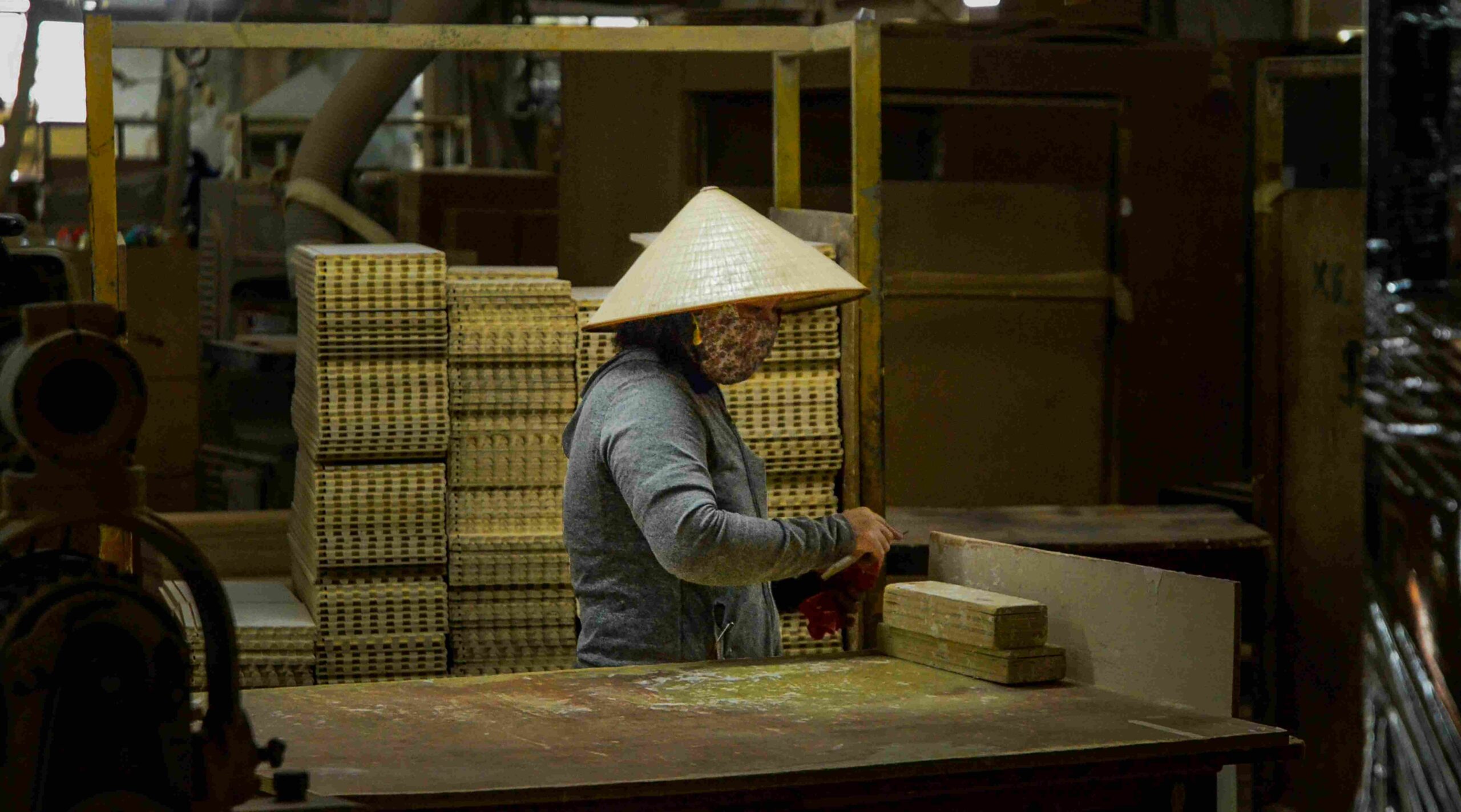
Modern bamboo manufacturing in Vietnam combines traditional skill with automated efficiency
Certifications & Compliance for Bamboo Products
Navigating compliance is simpler than you might expect if you ask the right questions upfront.
FSC® Certification: If you’re importing FSC-certified bamboo products, verify the factory holds FSC CoC (Chain of Custody) certification and maintains segregated inventory. FSC adds 5-10% to product cost but opens doors to eco-conscious retailers and justifies premium pricing to consumers.
Food Safety (U.S.): For cutting boards, plates, utensils, and any food-contact items, U.S. importers must meet FDA guidelines. Bamboo products should be tested for:
- CARB II compliance (formaldehyde limits in composite materials)
- TSCA Section 6 (restrictions on certain chemicals)
- FDA indirect food contact standards
- Microbial testing (E. coli, Salmonella)
Reputable factories test automatically and provide certificates. If they hesitate, move on.
EU Standards: If selling to European retailers, comply with CE marking requirements, particularly for children’s products (EN 71 for toys, EN 14373 for children’s dinnerware). Many factories cater to both U.S. and EU markets simultaneously.
Labor & Social Compliance: SA8000 or BSCI audits reassure retailers that workers are treated fairly. These certifications cost factories $5,000-10,000 annually but are increasingly standard in Vietnam’s bamboo sector.
Real Case Study: Sourcing Bamboo Kids’ Dinnerware Sets
A Portland-based children’s lifestyle brand was sourcing eco-friendly bamboo plates, bowls, and cups from a Chinese manufacturer. When tariffs jumped to 55% on China imports in mid-2025, their landed cost jumped $3 per unit set. With 100,000 units annual demand, that meant $300,000 in added cost—unsustainable without raising retail prices 20%.
They contacted Vietnam Direct Sourcing in July 2025. We identified three bamboo manufacturers in the Mekong Delta region with experience in children’s dinnerware. All three held FSC certification and had passing food-safety lab reports.
The brand requested samples with specific requirements: dishwasher-safe, non-toxic BPA-free finish, vibrant colors, and compliance with EN 14373 (EU children’s dinnerware standards, stricter than U.S. requirements). Two factories delivered within two weeks; both met specs.
Factory A quoted $2.80 per unit set (MOQ 20,000). Factory B quoted $2.65 but had longer lead times (75 days vs. 60). The brand chose Factory B for the cost advantage, reasoning that faster inventory turns would offset the longer production window.
The trial order was 25,000 units. Landed cost (including 20% Vietnam tariff, inspection, and shipping) came to $4.15 per unit—a $2.25 savings versus the Chinese supplier. On annual volume, that’s $225,000 in recovered margin.
Quality came flawless. Inspection found zero defects in the first container. The factory’s responsiveness to color requests and small custom features impressed the buyer so much that they expanded the relationship to include matching utensil sets and storage containers.
Key lesson: The tariff crisis became an opportunity to consolidate suppliers, improve margins, and build a partnership with more responsive, quality-focused partners.
Pricing & Logistics Reality Check
Understanding the full landed cost prevents surprises. Here’s a realistic breakdown for a $3 bamboo cutting board from a Vietnam factory:
| Cost Component | Amount |
|---|---|
| Factory Price (Ex-Works) | $3.00 |
| Inland Transport to Port | $0.15 |
| Inspection & Testing (amortized per unit) | $0.10 |
| Ocean Freight (Los Angeles, per unit) | $0.40 |
| U.S. Tariff (20% on Vietnam) | $0.73 |
| Drayage & Domestic Trucking | $0.25 |
| Insurance & Contingency | $0.12 |
| Total Landed Cost | $4.75 |
Lead time from order to U.S. port typically runs 60-75 days (production + inland transport). Ocean freight takes 20-25 days. Domestic delivery adds 5-7 days. Total: roughly 90-100 days from PO to warehouse. Plan accordingly—many importers hold a 60-day safety stock to avoid stockouts.
Shipping logistics are straightforward. Factories arrange LCL (less-than-container load) consolidation from Ho Chi Minh City or Da Nang ports. A 40-foot high cube costs $1,800-2,400 depending on season and destination. Inland trucking from a Vietnam factory to port typically runs $120-150 for a full container.
Quality Assurance Throughout the Supply Chain
Bamboo is a natural material, so moisture and environmental conditions matter. Here’s what vigilant importers watch for:
- Moisture Content: Properly dried bamboo should measure 8-12% moisture. If stored in humid warehouses pre-shipment, it can swell or warp. Request your factory store finished goods in climate-controlled warehouses.
- Splitting & Checking: Rapid humidity changes during ocean transit cause surface cracks (checking). Insist on proper containerization with desiccant packs to stabilize moisture during transit.
- Finish Consistency: Color variation across large orders is normal for natural bamboo, but you can minimize it by specifying tolerances and asking the factory to batch production to reduce color drift.
- Defects Caught Late: Pre-shipment inspection catches 95% of issues. Missing this step risks customer complaints and expensive returns.
Building Long-Term Partnerships
The best importers treat Vietnamese suppliers as partners, not transactional vendors. Small gestures yield big results: sending Tet gifts before the lunar new year, paying invoices on time, and giving 90-day forecasts so factories can plan production. Factory owners remember reliability and fairness.
As your relationship matures, you can negotiate better terms: higher volume discounts, faster lead times, and priority access to premium raw materials. Many factories reserve their best bamboo for long-term customers.
Getting Started: Next Steps
Your path to sourcing bamboo products from Vietnam follows a clear roadmap:
- Define your product spec: Write down exact dimensions, finish, certifications needed, and target cost. Share this with potential suppliers—it separates serious partners from casual contacts.
- Build a short list: Identify 3-5 factories using trade directories, peer recommendations, and industry connections. Request company profiles and references.
- Evaluate references: Call existing customers and ask hard questions about quality, reliability, and responsiveness to issues.
- Request samples: Pay the sample fee. A $100 investment eliminates surprises later.
- Conduct an audit: Visit in person or schedule a detailed virtual tour. Assess equipment, quality processes, and certifications directly.
- Run a trial order: Start with 20-30% of annual volume. Lock in specifications and payment terms. Test quality at scale before committing to larger volumes.
- Lock quality standards: Freeze a golden sample, establish pre-shipment inspection protocols, and implement lab testing for food-contact items.
- Scale with confidence: Once the trial succeeds, you’ve earned a trusted supplier relationship. Plan 6-12 month forecasts to help the factory optimize production.
Vietnam’s bamboo sector is mature, certified, and hungry for partnerships with serious importers. By following a disciplined sourcing process—specs first, samples second, audits third—you can access products that are sustainable, affordable, and precisely tailored to your market. The tariff environment makes Vietnam’s 20% rate even more attractive compared to China’s 55%, but the real advantage is the quality, responsiveness, and ESG credentials you unlock by building direct relationships with factories.
The importers winning in the bamboo market aren’t the ones chasing the lowest price. They’re the ones who invest time upfront—in specs, audits, and trials—to find partners who share their commitment to quality and sustainability. That discipline pays dividends in margin protection, customer satisfaction, and supply chain resilience.
That same discipline applies well beyond bamboo. See Sustainability in Global Sourcing: A New Standard for 2024 for how buyers are applying it across sourcing more broadly.
Tags: Find bamboo suppliers Vietnam | Bamboo manufacturers Vietnam | Bamboo sourcing Vietnam | Vietnam bamboo suppliers | Bamboo products Vietnam

Not sure where to start? See how our Vietnam sourcing solutions work, from supplier identification to quality assurance.
Learn more about this topic on our podcast!
Want to dive deeper into this subject? Check out our latest podcast on this subject on Spotify, where we explore this topic and so much more! Whether you're on the go or relaxing at home, tune in for insights, tips, and discussions that bring our blog topics to life.




Maximizing Your Business Potential Through Strategic Global Sourcing

Leave a comment
Your email address will not be published. Required fields are marked *