




AANZFTA vs CPTPP vs RCEP Trade Agreements for Australia & Vietnam
July 2026 – 10 min read
Here is a problem most importers do not know they have: Vietnam and Australia are linked by three overlapping free trade agreements, and defaulting to the wrong one is rarely about the duty rate — it is about compliance. For most finished consumer goods the duty outcome is zero under all three. The real exposure is preparing the wrong proof of origin, or claiming an origin you cannot defend, and having the preference refused or clawed back on entry into Australia, sometimes years later. AANZFTA, the CPTPP and RCEP all let goods move between Vietnam and Australia at preferential rates, but they set different rules of origin, different paperwork, and different certification regimes.
This guide breaks down the practical differences so you can choose the lowest-risk, lowest-paperwork route per product line. It is written for the decision-makers we work with every day: small and medium wholesalers and product owners in Australia and New Zealand who are moving production out of China and into Vietnam.
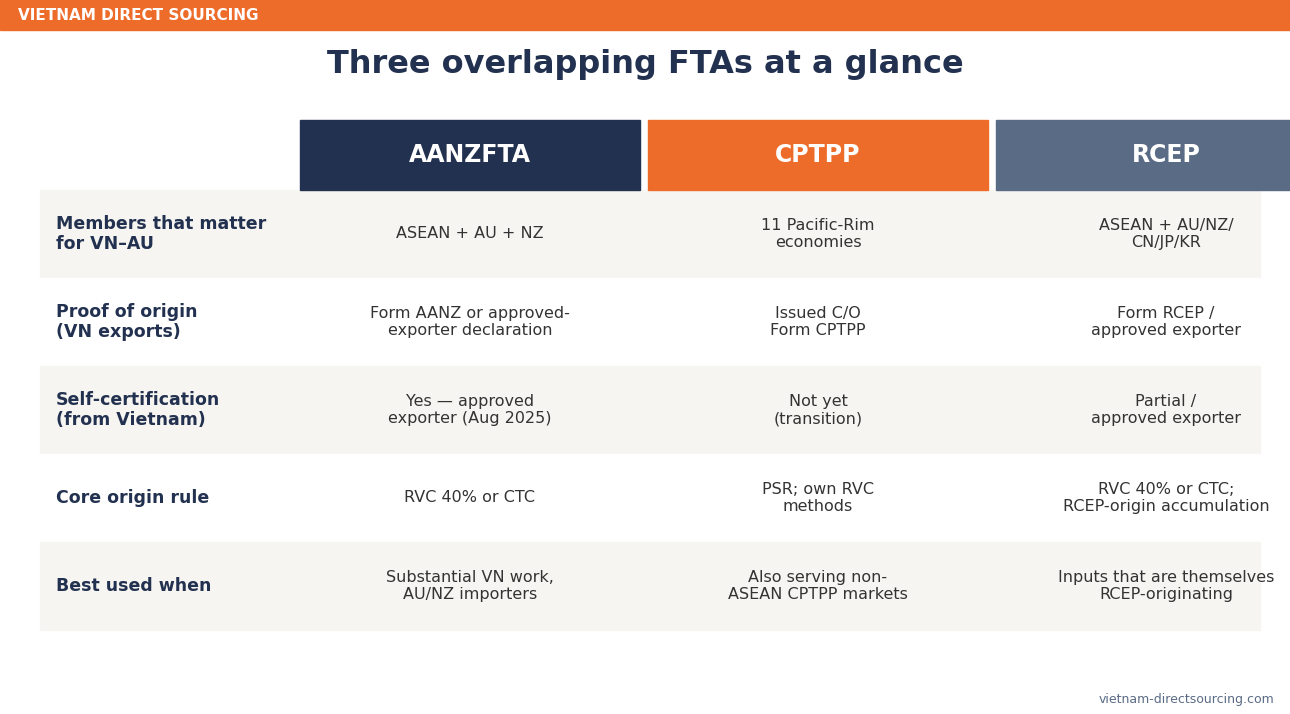
Figure 1: The same Vietnam–Australia shipment can qualify under three different agreements. The right one depends on your product, your inputs, and your paperwork.
First, why three agreements exist at all
Vietnam has signed more than 15 free trade agreements, and three of them cover Australia. AANZFTA (the ASEAN–Australia–New Zealand Free Trade Area, in force since 2010) is the original regional deal. The CPTPP (the Comprehensive and Progressive Agreement for Trans-Pacific Partnership, 2018) is the high-standard Pacific-Rim agreement. RCEP (the Regional Comprehensive Economic Partnership, 2022) is the newest and largest, pulling ASEAN together with Australia, New Zealand, China, Japan, and South Korea.
For a shipment moving from a Vietnamese factory to an Australian warehouse, all three can, in principle, deliver duty-free or near-duty-free entry. The catch is that “qualifying” means something different under each — and that is decided by your product’s tariff classification and its bill of materials, not by which agreement sounds best.
The tariff outcome is often the same — so origin rules decide
For most finished consumer goods that Australia imports from Vietnam — footwear, furniture, apparel, homewares, many electronics — the applied duty is already zero or near-zero under AANZFTA. CPTPP and RCEP frequently land in the same place. When the destination tariff is identical, the agreement you choose stops being about the rate and becomes about which rules of origin your product can satisfy, and which proof of origin is cleanest to produce and defend.
That is the mental shift that protects your margin: do not ask “which agreement has the lowest tariff?” Ask “which agreement’s rules of origin does my product pass most easily, with paperwork I can stand behind in an audit?”
Rules of origin: the real decision point
AANZFTA and RCEP share the same two familiar tests. A product typically qualifies if it meets a Regional Value Content (RVC) threshold — usually 40% of FOB value must originate in the free-trade area — or a Change in Tariff Classification (CTC), meaning the imported inputs are transformed enough to shift the finished good into a different tariff heading. CPTPP works differently: it relies heavily on detailed product-specific rules and, where it uses RVC, applies its own thresholds and several distinct calculation methods (including the focused-value and net-cost methods), so the “40% of FOB” shorthand does not carry across to it.
Under AANZFTA, whether RVC 40%, a change of tariff heading or a change of tariff sub-heading applies depends on the product-specific rule for your good’s HS classification; several categories, notably chemicals and machinery, offer a “CTSH or RVC” option. That flexibility tends to suit Vietnamese factories that import components but do substantial local work — but always check the rule for your specific HS code rather than assuming.
RCEP uses the same RVC 40% / CTC logic and adds accumulation across its members. The important limit: only materials that themselves qualify as originating in RCEP can be accumulated toward Vietnamese origin — full accumulation of the value added to non-originating materials is not in force. So Chinese, Japanese or Korean inputs help only where those inputs already meet RCEP’s own origin rules. For some products that makes RCEP the cleanest route; for others it changes nothing. It is a per-product question.
CPTPP tends to apply stricter, more product-specific rules — the textile “yarn-forward” rule is the classic example — and does not let you count non-originating inputs from outside the CPTPP bloc, including Chinese inputs, toward origin. Whether that helps or hurts depends entirely on the product and its HS classification. For many straight Vietnam-to-Australia moves CPTPP is not the easiest path, but it earns its keep when you are also serving non-ASEAN CPTPP markets such as Canada, Mexico or Peru with a single origin logic.
Proof of origin: where the paperwork diverges
This is the part most traders overlook, and since August 2025 it has changed in an important way.
AANZFTA now offers two routes. Under the Second Protocol — in force for Australia and New Zealand, and applied by Vietnam from 22 August 2025 — proof of origin may be either an issued Certificate of Origin (Form AANZ) or a declaration of origin made by an approved exporter. Vietnam implements this through Circular No. 44/2025/TT-BCT (Articles 21, 24 and 25). Form AANZ is issued by the Import-Export Department of the Ministry of Industry and Trade and by bodies assigned by provincial People’s Committees — no longer the VCCI. For an RVC claim, the FOB value is declared in the field designated on the current Form AANZ; confirm the box number against the form annexed to Circular No. 44/2025/TT-BCT.
CPTPP is the opposite of what many expect. For goods leaving Vietnam, exporter or producer self-certification is not yet available: Vietnam still requires an issued C/O Form CPTPP under Circular No. 03/2019/TT-BCT (as amended by Circular No. 06/2020/TT-BCT), with a transition period of five to ten years before exporter self-certification comes in. Importer self-certification took effect on 14 January 2024, but that concerns goods entering Vietnam, not goods you are shipping to Australia.
RCEP sits in between, using a Form RCEP Certificate of Origin or an approved-exporter declaration of origin, under a single framework that can travel across all member countries.
The practical picture is close to the reverse of the old rule of thumb. Today a Vietnamese exporter generally has easier access to self-certification under AANZFTA — as an approved exporter — than under CPTPP, where an issued certificate is still required for exports. An authority-issued certificate still has its place: for a first order, or where you would rather a third party stand behind the origin claim, an issued Form AANZ remains the low-dispute option.
A worked example: how the right pick changes the math
The situation. An Australian homewares wholesaler we advised was sourcing ceramic-and-metal kitchen products from a Vietnamese factory. The factory imported roughly 45% of its input value (metal fittings and glazes) from China and did the forming, firing, assembly and finishing in Vietnam. A freight forwarder had told the buyer to “just use CPTPP.”
The problem. “Just use CPTPP” skips the only step that matters: reading the product-specific rule for the good’s HS classification. Origin is decided rule by rule, not by a general preference — so the first job was to classify the product and pull the applicable rule under each agreement.
The approach. We ran the bill of materials against the product-specific rule for each agreement. Under AANZFTA, if the Vietnamese forming, firing and finishing achieve the change in tariff classification the rule requires, the good qualifies on transformation alone — regardless of the Chinese input share — and can travel on an issued Form AANZ or an approved-exporter declaration. Under RCEP, the test is RVC-based, and the Chinese fittings help only to the extent they are themselves RCEP-originating. Under CPTPP, the applicable rule and RVC method (and the exclusion of non-CPTPP inputs) have to be checked against the same HS classification before any conclusion can be drawn. The buyer went with AANZFTA: the same zero duty, the cleanest paperwork, and — importantly — a documented reason, tied to the HS code and the rule, for why the goods qualify.
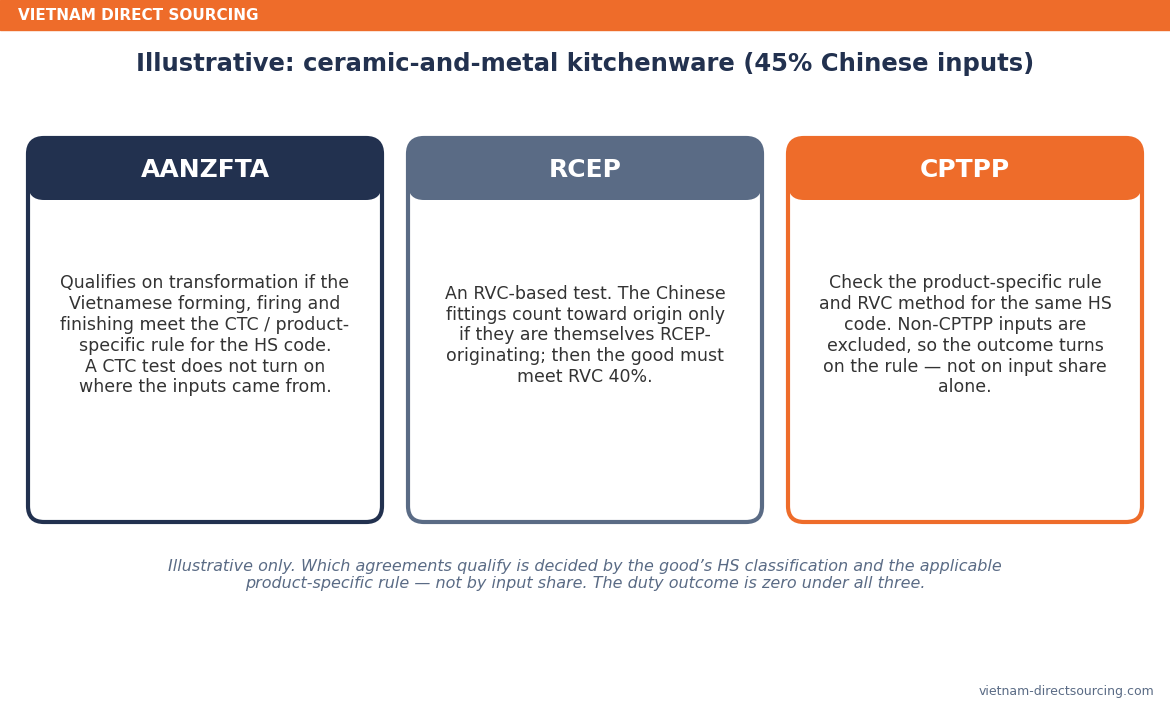
Figure 2: The same shipment, tested rule by rule. Which agreements qualify depends on the good’s HS classification and the applicable product-specific rule — not on the headline duty rate, which is zero under all three.
A simple decision framework
Use this order of questions per product line, not per supplier:
Do significant inputs come from China, Japan or Korea, and do those inputs themselves qualify as RCEP-originating? If so, RCEP’s accumulation may be the route that gets you over an RVC threshold — start there.
Is the good made substantially in Vietnam and bound for Australia or New Zealand? AANZFTA is usually the cleanest fit, and you can now use either an issued Form AANZ or, as an approved exporter, a declaration of origin.
Are you also shipping to Canada, Mexico, Japan or other CPTPP markets? Keep CPTPP in play so one origin logic can serve several destinations.
Do you want to self-certify to cut paperwork, and can you defend it in an audit? For exports from Vietnam that currently points to AANZFTA (as an approved exporter) or RCEP; an issued certificate is still required under CPTPP.
The winning move is rarely picking one agreement for your whole catalogue. It is matching each product line to the agreement whose rules of origin it passes most easily at the lowest paperwork cost — and documenting why, against the HS code and the applicable rule.
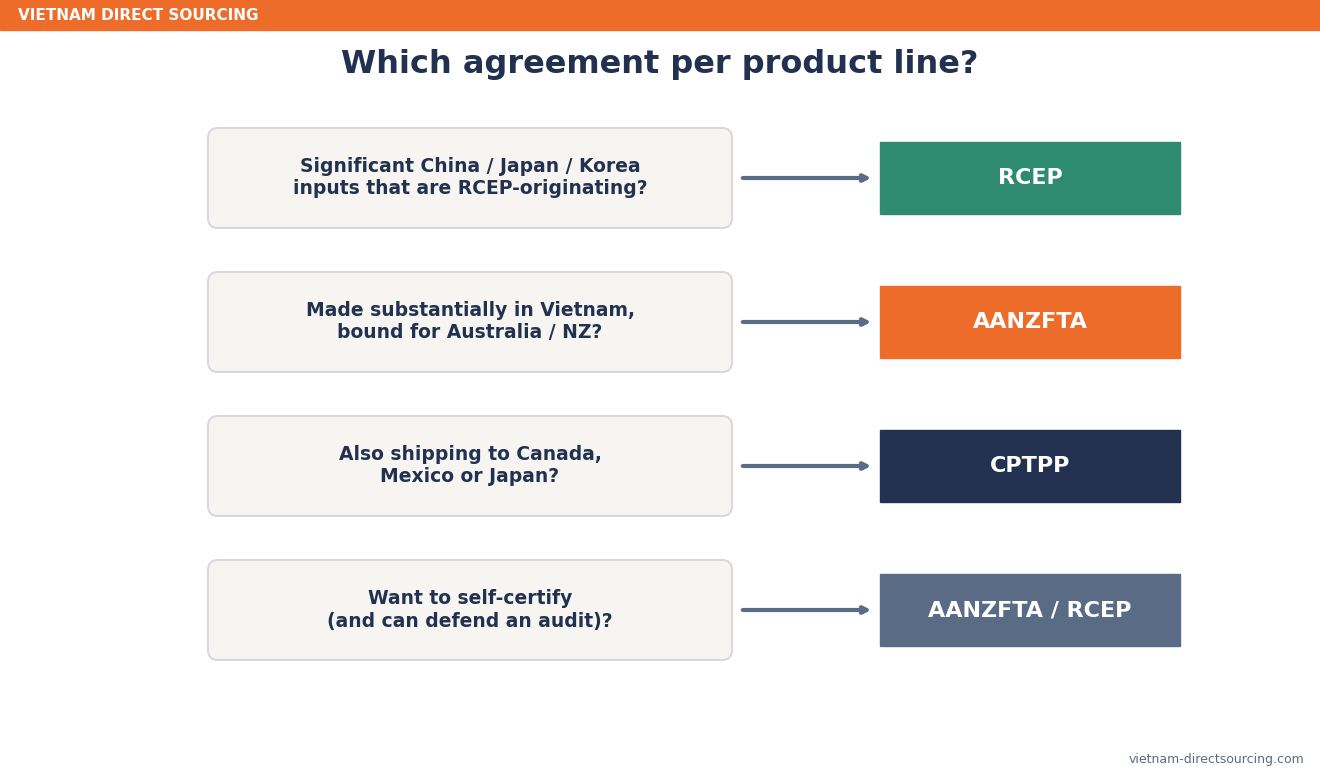
Figure 3: A quick decision path — answer these in order, per product line, to land on the right agreement. Confirm the result against the good’s HS classification and product-specific rule.
Two rules that quietly sink preference claims
Even a perfectly satisfied origin rule can be undone at the border by two things buyers rarely plan for. The first is the consignment, or non-alteration, requirement: to keep preference, the goods generally must be shipped directly, and if they pass through a third country they must stay under customs control and not be altered beyond what is needed to keep them in good condition. Break that chain — a little re-packing or re-labelling in a transhipment hub — and the claim can fail even though the goods genuinely originate in Vietnam. Keep the through bill of lading and any transhipment documentation.
The second is timing. If the proof of origin is not ready when the goods arrive, all three agreements allow a claim for preference to be made after importation, with the duty refunded once a valid certificate or declaration is lodged within the period the importing country allows. It is worth knowing that window in Australia before you need it, rather than discovering it after paying duty you could have reclaimed.
Common mistakes that cost money
Letting the forwarder choose. Freight forwarders optimise for moving boxes, not for your landed cost or audit exposure. The agreement choice is a sourcing and compliance decision, informed by your bill of materials and HS classification.
Using one agreement for everything. A catalogue with mixed input origins almost always splits across agreements. Treating it as one-size-fits-all leaves compliance risk on the table.
Claiming origin you cannot prove. An incorrect certificate or declaration can trigger back-duties and penalties years later. Good practice is to confirm, before you order, that your factory can actually document the origin you intend to claim.
Ignoring the certification regime. The route that looks simplest on paper is not always the one available for your trade. For exports from Vietnam, an issued Form AANZ or an approved-exporter AANZ declaration is often the cleanest option, while CPTPP still requires an issued certificate.
The bottom line
For Vietnam–Australia traders, AANZFTA, CPTPP and RCEP are not competitors to rank once — they are three tools to assign per product line. For most finished goods made substantially in Vietnam, AANZFTA now offers zero duty with the most flexible, most defensible paperwork, thanks to the Second Protocol’s approved-exporter route. Where your inputs lean on China, Japan or Korea and those inputs are themselves RCEP-originating, RCEP’s accumulation can be decisive. CPTPP mainly earns its place when you are also serving non-ASEAN Pacific markets. Get the mapping right — confirmed against the HS code, the product-specific rule and the certification regime — and you protect both your margin and your compliance record.
A note on sources. The rules of origin sit in AANZFTA Chapter 3 (as amended by the Second Protocol), CPTPP Chapters 3 and 4, and RCEP Chapter 3, implemented in Vietnam through the circulars cited above. Whatever this article suggests, the choice of agreement for any given shipment should be confirmed against the good’s HS classification, the applicable product-specific rule, and the certification regime in force between the two Parties at the time of export.
Legal position stated as at July 2026. AANZFTA’s certification rules changed in August 2025 under the Second Protocol, and further change is possible as the remaining Parties implement it; confirm the current requirements before preparing origin documentation.
Source: Written by Rod Smith, Vietnam Direct Sourcing
Not sure where to start? See how our Vietnam sourcing solutions work, from supplier identification to quality assurance.
Learn more about this topic on our podcast!
Want to dive deeper into this subject? Check out our latest podcast on this subject on Spotify, where we explore this topic and so much more! Whether you're on the go or relaxing at home, tune in for insights, tips, and discussions that bring our blog topics to life.

How to Find Curcumin & Turmeric Extract Suppliers in Vietnam

Leave a comment
Your email address will not be published. Required fields are marked *